
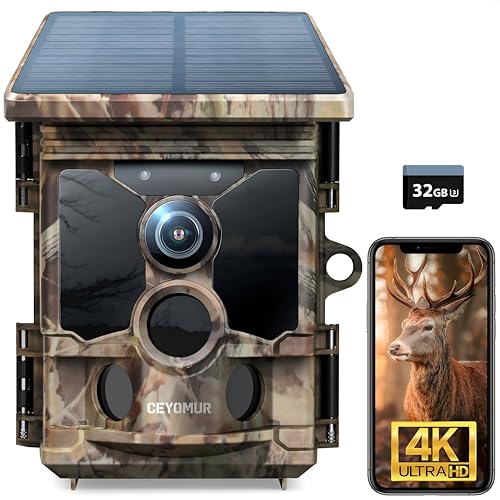
CEYOMUR
CY95 4K Solar WiFi
$59.99
Pros & Cons
Pros
- Top-mounted solar plus a 5200mAh battery plus AA fallback — triple power for the price
- 4K 30fps video and high-MP stills at a budget-WiFi price
- Free local app with zero subscription
- 0.1s trigger is genuinely fast for the money
- No-glow flash keeps it discreet in the yard
Cons
- WiFi range is only ~33 ft — strictly a stand-right-next-to-it tool
- Off-brand app and firmware carry more reliability risk than name brands
- Detection range trails the GardePro and Browning cams
At a Glance
Overview
The CEYOMUR 4K Solar WiFi is the cheapest way we have found to get solar power and 4K video in one trail camera with zero monthly fees. For around the price of a single month or two of some cellular plans, you get a top-mounted solar panel, a 5200mAh built-in battery, AA fallback, a 0.1-second trigger, and a free local app. On paper that is an absurd amount of camera for the money, and for the right buyer it genuinely delivers.
The key word is local. This is a WiFi camera, not a cellular one, which means it does not send photos off-site over a data network. Instead you pair to it with your phone over its own short-range WiFi and Bluetooth, standing near the camera, and pull images directly with no subscription involved. That no-fee model is the whole point: over three years a cellular camera can cost you $200 to $600 in data plans alone, and the CEYOMUR costs nothing beyond the purchase. If you understand and accept the range limitation, the savings are real and permanent.
The honest catches are range and software. The WiFi range is roughly 33 feet, which is genuinely short even by no-fee WiFi standards, so this is strictly a stand-right-next-to-it camera. And as an off-brand product, its app and firmware carry more reliability risk than a name brand like GardePro or Browning. Owner reviews are a mix of delighted value-hunters and frustrated users who hit firmware quirks, which is the gamble you take at this price. Detection range also trails the better cameras in the class.
This review covers how the CEYOMUR performs as a backyard and secondary camera, how the no-fee WiFi and SD-card workflow actually works in practice, how the triple-power solar system holds up including in winter, and whether the budget price and off-brand risk add up for your situation.
CEYOMUR 4K Solar WiFi Trail Camera (Built-in Battery + Top Solar)
Prices may change · Free shipping with Prime
Design, Build & Theft Resistance
The CEYOMUR is a compact box camera with a solar panel built into the top of the housing, so the whole package is self-contained with nothing to mount separately. It carries an IP66 weatherproof rating, which is a step above basic weatherproofing and means it handles heavy rain and dust well, a genuine plus at this price. The build is budget-appropriate: it does the job and closes securely, but it does not feel like a premium camera in the hand, which is exactly what you should expect for the money.
Mounting is standard strap-and-tree, and the integrated solar panel means you simply hang it where it gets sun and you are done. Because the panel is fixed on top of the body, you do have to balance aiming the camera at your subject with giving the panel sky, which is the usual integrated-solar compromise, but for backyard use that is rarely a problem.
Theft resistance is worth a realistic word. This is an inexpensive camera, so the financial sting of losing one is small, but it has no cellular connection, which means if it is stolen there is no GPS tagging and no off-site photos to fall back on; everything lives on the SD card inside, so a thief gets your images too. For backyard use on your own property, where most CEYOMUR cameras live, theft is a minor concern. If you are putting it anywhere less controlled, a basic security box and cable lock are cheap insurance, and you should weigh whether a no-connectivity camera is the right choice for a spot where theft is a real risk, since you would lose both the hardware and the photos with no recovery path.
Detection & Trigger Speed in the Field
The CEYOMUR's standout field spec is its 0.1-second trigger, which is genuinely fast for the money and a real surprise at this price. A 0.1-second trigger keeps pace with fast-moving backyard wildlife and deer that walk through quickly, the kind of subjects a slow budget camera would miss entirely. This is the spec that makes the CEYOMUR more than a toy: it can actually catch action, not just animals that stop and pose.
Detection range is the weaker side of the equation, rated around 80 feet but trailing the GardePro and Browning cameras in real-world reach. As with every PIR trail camera, the rated number is a best case that drops in cold weather and open settings, so plan for a tighter reliable trigger zone and place the camera closer to where you expect activity. The flash range is also modest at around 65 feet, so night subjects need to be reasonably close to light up well. Match your placement to those shorter ranges and the camera performs; stretch it across a wide field and it will miss things at distance.
On image quality, the CEYOMUR advertises high-megapixel stills and shoots 4K 30fps video, which is the headline that sells it. The megapixel figure is interpolated, as it is on nearly every trail camera and especially on budget models, so do not read the spec as native detail. The honest reality is that daytime images and 4K video are good for the price, clearly usable for backyard wildlife and casual identification, but not on the level of a Sony Starvis sensor or a premium camera. The no-glow flash keeps night shots discreet, and within its modest flash range the night images are perfectly serviceable. Treat the resolution specs as marketing-inflated but the real-world output as solid value, and you will be satisfied.
Night Flash: No-Glow vs Low-Glow
The CEYOMUR uses a no-glow infrared flash, which is the more covert of the two infrared options and a genuine plus on a budget camera. True no-glow LEDs operate around the 940nm wavelength and produce no visible light when they fire, so neither animals nor people see the flash go off at night. That makes the CEYOMUR discreet in the backyard or anywhere you do not want the camera announcing itself, and it is notable that a camera this cheap includes a no-glow flash at all when many budget cameras cut costs with a visible low-glow array. Our no-glow versus low-glow guide explains the full trade-off between the two.
The trade that comes with no-glow is the one every no-glow camera makes: 940nm light is less efficient than the 850nm light a low-glow flash uses, so no-glow night images are typically a little dimmer and shorter-reaching than low-glow shots at the same power. On the CEYOMUR this shows up as a modest flash range of around 65 feet, meaning night subjects need to be reasonably close to the camera to light up well. Combined with the camera's shorter detection range, this reinforces the same placement lesson: put the CEYOMUR near the action, not far from it.
For the backyard wildlife and casual use this camera is built for, the no-glow flash is the right choice and a nice bonus at the price. You get discreet operation, your subjects are not spooked by a visible flash, and within the camera's modest night range the images are clean. Just keep your expectations matched to the flash range; this is not a camera that throws light across a big open area at night, and no budget no-glow camera is.
WiFi & SD-Card Workflow — No Monthly Fee
This is the section that defines whether the CEYOMUR is right for you, because the no-fee WiFi model is the entire reason to buy it. The CEYOMUR does not use a cellular network. Instead, it creates its own short-range WiFi connection that you pair to with your phone over Bluetooth and the free CEYOMUR app, standing near the camera. You walk up, connect, and pull photos and video directly off the camera to your phone, with no subscription, no SIM, and no data fees ever. Everything is also recorded to the microSD card inside, so the card is your backup and your bulk storage.
The crucial gotcha is range. The CEYOMUR's WiFi reaches only about 33 feet, which is short even among no-fee WiFi cameras; for comparison, a GardePro E8 reaches roughly 45 feet and the dual-antenna E8 2.0 can stretch much farther in the open. At 33 feet, the CEYOMUR is strictly a stand-right-next-to-it tool. You cannot check it from your porch, your truck, or across the yard; you have to walk up to within a few paces of the camera to connect. For a backyard camera you pass by anyway, this is a minor inconvenience. For any spot you would have to make a special trip to reach, the short range largely defeats the convenience, and you would be better served by a cellular camera or simply pulling the SD card.
The payoff for accepting that limitation is the money. A cellular camera's data plan runs roughly $60 to $200 a year and more on premium tiers, which over three years can exceed the cost of the camera itself. The CEYOMUR costs nothing beyond the purchase price, forever. If your use case fits the short range, that is a genuine and permanent savings, and it is why the no monthly fee category exists. Our no monthly fee guide lays out exactly when the WiFi or SD workflow beats paying for cellular, and the CEYOMUR is a textbook case of the budget end of that trade.
Power, Batteries & Solar / Cold Weather
Power is one of the CEYOMUR's real strengths and a big part of its value: it offers triple power. The top-mounted solar panel feeds a 5200mAh built-in rechargeable battery, and there is also AA fallback if you need it. That combination means the camera can run a long time on solar alone in a sunny spot, fall back on the internal battery through cloudy stretches, and accept AAs as a backup if the battery ever runs down. For a budget camera to include all three power paths is genuinely generous and a strong argument for the value.
In practice, in a spot with adequate sun, the solar keeps the 5200mAh battery topped and the camera runs largely unattended, which is the set-and-forget experience the marketing promises. Because this is a local WiFi camera rather than a cellular one, it does not burn power on data uploads the way a cell cam does, so its power demands are more modest, and the solar has an easier job keeping up.
The winter caveat applies as it does to all solar. Short days, low sun angles, and snow on the fixed top-mounted panel cut charging in the coldest months, and because the panel is integrated you cannot reposition it to chase low-angle winter sun. The 5200mAh battery buffers through lean periods, and the AA fallback is your insurance: if a long cold, cloudy stretch drains the internal battery, you can drop in lithium AAs to keep the camera running rather than waiting on the sun. For the best cold-weather reliability, run lithium AAs rather than alkaline in the fallback slot, since lithium holds voltage in the cold where alkaline sags. Give the panel the most open sky you can and the triple-power system handles most situations a backyard camera will face.
Who Should Buy (And Who Shouldn't)
Buy the CEYOMUR if you want maximum value for a backyard or secondary camera and you accept the short WiFi range and off-brand software gamble. For watching wildlife in your own backyard, monitoring a feeder or garden, or adding a cheap extra camera to cover another spot, it delivers an outsized feature set, solar power, 4K video, a fast 0.1-second trigger, a no-glow flash, and triple power, for a budget price with no monthly fees ever. For a beginner who wants to try a trail camera without committing real money or signing up for a data plan, it is a low-risk entry point. And for anyone running a near-the-house spot they pass by anyway, the 33-foot WiFi range is a non-issue and the no-fee savings are pure win.
Do not buy the CEYOMUR if you need to check the camera from a distance or off-site; the 33-foot WiFi range means you must stand right next to it, and for any spot you would make a special trip to reach, a cellular camera makes far more sense. Skip it if you cannot tolerate firmware and app reliability risk, because as an off-brand product it carries more of that risk than a name brand, and the support is not on the level of GardePro or Browning. Skip it too for a spot where theft is a real concern, since with no cellular connection a stolen camera takes your photos with it and offers no recovery path. And if you want the best possible image quality or the longest detection and night range, a higher-tier camera will outperform it. Matched to its job, a cheap, no-fee, solar backyard camera, it is hard to beat on value; pushed beyond that, its limits show quickly.
Alternatives Worth Considering
The most important alternative is the GardePro E8 2.0, which is the no-fee WiFi camera to buy if you want more reliability and far more range. It shoots 4K with a 64MP sensor, uses dual-antenna WiFi 6 that stretches usable range to roughly 165 feet in the open versus the CEYOMUR's 33 feet, and comes from an established brand with better firmware and support. It costs more, but for anyone who found the CEYOMUR's short range or off-brand risk concerning, the E8 2.0 fixes both while keeping the zero-monthly-fee model.
If you do not need WiFi at all and just want the best budget image quality with no fees, the GardePro A3S is the pick. It drops the WiFi convenience for straight SD-card operation but adds a Sony Starvis night sensor that genuinely rivals cameras three times its price, a 100-foot detection range, and a fast trigger, all for a low price. For a backyard or near-trail spot where you do not mind pulling the card, it produces better images than the CEYOMUR.
If the no-fee, solar, set-and-forget concept appeals but you want photos sent to your phone from a remote spot, you have to step into cellular, where the Spypoint Flex-S offers integrated solar and a free 100-photo plan that keeps recurring cost optional. That is the bridge between the CEYOMUR's no-fee local model and true off-site checking. Our no monthly fee, backyard wildlife, and brand showdown guides walk through exactly where the CEYOMUR's budget no-fee approach wins and where spending more pays off.
Our Verdict
The cheapest way to get solar plus 4K with no fees. A solid backyard or secondary cam if you accept the very short WiFi range and the off-brand software gamble.
CEYOMUR 4K Solar WiFi Trail Camera (Built-in Battery + Top Solar)
$59.99
Prices may change · Free shipping with Prime
| Full Specifications | |
|---|---|
| Connectivity | wifi |
| Monthly fee | None |
| Night flash | no-glow |
| Photo resolution | 68MP |
| Trigger speed | 0.1s |
| Detection range | 80ft |
| Flash range | 65ft |
| Power | Solar + rechargeable (AA fallback) |
| Weather rating | IP66 |
| Storage | microSD |
| Video | 4K |
Frequently Asked Questions
Does the CEYOMUR really have no monthly fee?
How far does the WiFi reach?
Is the off-brand app and firmware reliable?
Does the solar eliminate battery swaps?
Is the flash visible at night?
How good is the 4K video really?
Is it good for security?
Should I use AA batteries or rely on solar?
Related Buying Guides
Compare With Similar Trail Cameras
Head-to-Head Comparisons
CEYOMUR 4K Solar WiFi Trail Camera (Built-in Battery + Top Solar)
$59.99
Prices may change · Free shipping with Prime