
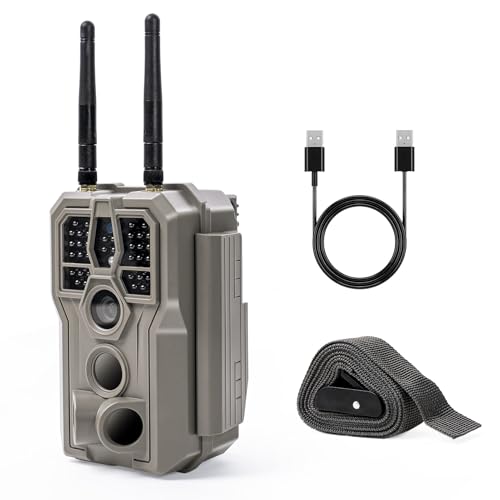
GardePro
E8 2.0
$89.99
Pros & Cons
Pros
- 4K video and 64MP stills with no subscription — the resolution leader among no-fee cams
- Dual-antenna WiFi 6 stretches usable connection range to ~165 ft in the open
- 0.1s trigger keeps pace with fast wildlife and deer
- No-glow flash and IP66 build handle covert, all-weather use
- Solar-ready, with a rechargeable Pro variant available
Cons
- Still local-only — no cellular, so no off-site checking
- 4K eats card space fast; budget a high-capacity microSD
- Real-world WiFi range drops well below 165 ft through brush
At a Glance
Overview
The GardePro E8 2.0 is what you get when a company takes its already-popular no-fee WiFi camera and fixes the two things owners griped about most: not enough resolution and not enough range. The result is the resolution-and-reach leader of the no-subscription crowd — 4K video, a 64-megapixel still mode, and a dual-antenna WiFi 6 radio that stretches usable local connection out toward 165 feet in the open, all without a single dollar of monthly fees. For people who liked the original E8 idea but felt tethered to it, this is the upgrade.
It keeps everything that made the first E8 a budget darling: the 0.1-second trigger that actually catches walking deer, the triple-PIR detection reaching a true 100 feet, the covert no-glow flash, and the IP66 weatherproof body that takes rain and snow in stride. Then it layers on the headline specs and the longer leash. At around $90 to $100 it's still firmly a budget-to-mid camera, but it's the one I hand someone who says "I want photos on my phone, I never want to pay a fee, and I'm tired of standing right on top of the camera to get them."
The honest framing, though, is the same as it was: "WiFi" here means a local link between camera and phone, not the internet. The dual-antenna WiFi 6 buys you real extra distance — meaningful when you can connect from across a clearing instead of from under the tree — but it does not turn this into a cellular cam. You still walk to the general area, you just don't have to hug the trunk anymore. If you need to check a camera from town, this is not that tool, and no amount of antenna helps.
This review walks the whole thing: where the 64MP and 4K numbers come from and what they actually buy you, how far the WiFi 6 range holds up once brush gets involved, whether the no-glow flash stays covert, and who should spend the extra over the original E8 or jump to cellular instead. If 4K and the longest no-fee range are your priorities, the E8 2.0 is the camera to beat in this lane.
GardePro E8 2.0 WiFi 6 Bluetooth Trail Camera (Dual Antenna, 4K)
Prices may change · Free shipping with Prime
Design, Build & Theft Resistance
Physically the E8 2.0 looks like its predecessor with two small giveaways: the dual external antenna stubs and a slightly refined case. The matte camo finish hides well on bark, and the body is compact enough for a single strap on a modest tree while staying rigid in wind. The gasketed door seals the SD slot, battery tray, ports, and setup screen, and the IP66 rating has held up to the wet weather I've thrown at it. The dual antennas are the visible cost of the longer range; they stick up enough that you'll want to mind them when tucking the cam into tight cover, but they don't materially hurt concealment.
Mounting options are the usual GardePro set: the strap channel, a tripod thread underneath for posts and custom mounts, and a slot that accepts a python cable lock. Setup is mostly done in the app after hanging, but the on-camera screen covers the basics if you're caught without a phone.
Theft resistance is, as with the whole E8 line, minimal by design. There's no GPS, no locking latch, and no covert recovery feature — the no-glow flash keeps it from announcing itself at night, but if someone finds and grabs it, the camera can't help you get it back. For private land, backyards, and near-cabin use that's fine. On a public-access lease or any spot where strangers roam, plan on a steel lockbox and a cable as part of the purchase. The camera's value is high enough relative to its theft defenses that the box is cheap insurance.
Detection & Trigger Speed in the Field
The detection chain carries straight over from the E8 and remains the camera's strongest trait. The 0.1-second trigger is the real thing — fast enough to put a moving deer in the center of the frame rather than catching its hindquarters leaving — and the triple-PIR sensor reaches a genuine 100 feet on the spec sheet, with reliable usable triggers out past 80 feet in open hardwoods. Recovery between shots is quick, so you get follow-up frames of the same animal instead of one lonely picture.
Now the resolution truth, because the E8 2.0's headline numbers demand it. The box advertises 64MP stills and 4K video. The 64MP is interpolated — the native sensor is much smaller, and the camera scales the image up in software. Interpolation adds pixels, not real detail, so a 64MP file from this cam is not equivalent to 64MP from a dedicated camera. What it does give you is a large, clean, sharp image with a bit more apparent crispness than the original E8's 48MP mode, and plenty of headroom to crop into a buck's rack or a face. The 4K video, by contrast, is closer to a real upgrade you can see: footage is noticeably more detailed than 1080p in good light, with smooth motion and audio.
The practical caveat with 4K is storage and battery. Those files are big — they fill a card fast and pull more power both to record and to download over WiFi — so size your microSD generously (a 128GB+ high-endurance card) and lean toward photo mode or shorter clips if runtime matters. For pure scouting and patterning, the E8 2.0's capture quality is excellent for the money; just treat the 64MP figure as marketing math and the 4K as the genuine step forward.
Night Flash: No-Glow, Low-Glow or White?
The E8 2.0 runs a no-glow infrared flash using 940nm LEDs — the covert end of the IR spectrum. There's no visible red glow when it fires, so pressured deer that have learned to clock the faint wink of an 850nm low-glow cam won't see this one, and a property camera won't betray its own location to anyone walking by at night. For hunting and discreet security alike, no-glow is the choice most serious users want, and the E8 2.0 delivers it.
The physics tradeoff is unchanged: 940nm light reads dimmer to the sensor than 850nm, so no-glow cams generally give up a little night brightness and reach in exchange for invisibility. The E8 2.0 handles this competently for its class — night stills are evenly lit out to the effective flash range without a blown-out hotspot in the center, and there's enough detail to identify animals clearly. Beyond the usable flash distance the image goes dark, as it does on every IR camera, so place it for the range you actually need rather than the number on the box.
If full-color night images are your real requirement — recognizing a face, reading a plate, distinguishing two similar deer by coat — the E8 2.0 is the wrong tool, and you'd want a white-flash camera like GardePro's E8P, accepting that white flash is highly visible and will spook game. For covert, no-one-sees-it night coverage with solid detail, the E8 2.0's no-glow is exactly right. This is the standard no-glow versus low-glow versus white-flash decision, and the E8 2.0 plants itself firmly on the covert no-glow side.
WiFi & SD-Card Workflow — No Monthly Fee
The workflow is the whole reason this camera exists, and the E8 2.0 improves the part people complained about. Like the original, it has no cellular radio — it creates its own short-range local network. You open the GardePro app, it wakes and pairs the camera over Bluetooth first, then hands the connection over to the camera's WiFi to browse, download, and adjust settings. Cost after purchase: nothing, forever. No plan, no per-photo charge, no renewal.
The upgrade is the dual-antenna WiFi 6 radio, which pushes usable connection range to roughly 165 feet in open conditions — a real, felt improvement over the original E8's ~45 feet. In practice that means you can often connect from the edge of a clearing, from a stand a short distance away, or from across a yard rather than standing directly beneath the camera. Be realistic, though: that 165-foot figure is open-air. Brush, tree trunks, terrain, and walls cut it down hard, so in thick cover you'll still find yourself walking closer than the spec suggests. It extends the leash; it does not cut it.
What it is not, still, is remote access. There's no checking this from home or from miles away — for that you need a true cellular camera and the data plan that comes with it. And that's the deliberate trade of the no-monthly-fee category: you give up over-the-internet checking to never pay again. The savings are concrete — cellular plans run roughly $60 to $200 a year — so over a few seasons the E8 2.0 owner pockets hundreds of dollars. Everything also writes to the microSD card as the system of record, so the card remains your guaranteed backup if the app ever misbehaves.
Power, Batteries & Cold Weather
The E8 2.0 runs on 8 AA batteries, and the 4K capability makes battery choice even more important than it was on the original. Skip alkalines for any serious deployment — they sag in the cold, their drooping voltage can trip false low-battery shutdowns, and they're more prone to leaking and ruining contacts. Lithium AAs (Energizer Ultimate Lithium and equivalents) hold voltage flat across their life, weigh less, survive deep cold, and resist leaking; in a camera you're leaving out through a season they pay for themselves. Rechargeable NiMH AAs work but their lower voltage can weaken flash output and shorten effective runtime.
Real-world battery life swings widely with how you use it. Stills-only on a moderate trail with lithium AAs can stretch multiple months; heavy 4K video plus frequent WiFi downloads (the radio and large file transfers are power-hungry) can cut that dramatically. If runtime is your priority, favor photo mode or short clips and resist the urge to connect and browse every visit. The 4K is glorious but it is the single biggest battery and storage drain on the camera.
For long unattended runs, the E8 2.0 is solar-ready — GardePro's compatible panel plugs into the external port and trickle-charges to extend or eliminate battery trips on a sunny site, which pairs especially well with power-hungry 4K use. GardePro also offers a rechargeable Pro variant in this family if a built-in pack appeals more than swapping AAs. In genuine cold the rule is the same as ever: run lithium AAs or solar and the E8 2.0 keeps shooting long after alkaline-fed cameras have quit.
Who Should Buy (And Who Shouldn't)
Buy the GardePro E8 2.0 if you want the highest resolution and the longest local range in a no-subscription camera, and you're generally within a clearing's distance of the spot. It's the pick for serious backyard and homestead users who want 4K of their wildlife, for hunters scouting food plots and edges near the truck who appreciate connecting from a bit further out, and for anyone who liked the original E8 but felt the 45-foot tether was too short. The fast trigger, long detection, covert no-glow flash, and genuine 4K make it the strongest all-around no-fee WiFi cam in this catalog.
Don't buy it if your real need is checking a camera you can't conveniently reach. Even 165 feet of open-air WiFi means you're still going to the property — if that trip is the problem, you want a cellular cam (Tactacam, Spypoint, Moultrie) and you should accept the data plan. Also skip it if you specifically need color night ID for security, which is the white-flash E8P's domain, or if you simply want the best night stills on a budget with no connectivity at all, where the SD-only A3S is the smarter, cheaper choice.
And be honest about the 4K: if you'll only ever pull stills and view them on a phone, you may be paying for resolution and a power-and-storage burden you won't use, in which case the original E8 or even an SD-only cam saves money. But if you genuinely want 4K wildlife footage and the longest no-fee reach available, the E8 2.0 is the one to get.
Alternatives Worth Considering
The most direct comparison is the original GardePro E8. It drops to a 48MP interpolated sensor, 1296p video instead of 4K, and a single-antenna WiFi radio good for only about 45 feet — but it's cheaper and easier on batteries and cards. If you don't truly need 4K or the extra range, the original E8 saves money and power while keeping the same fast trigger and no-glow flash. The E8 2.0 is worth the upgrade specifically for resolution and reach; if those don't move you, the original is the value play.
If you'd rather skip WiFi entirely for the best night image quality per dollar, the GardePro A3S is the standout. It's SD-card only — you pull the card instead of pulling over WiFi — but its Sony Starvis sensor produces night stills that rival cameras three times the price, all for under $60. For pure photo quality without any connectivity, it's the better buy.
For the cheapest path to solar plus 4K, the CEYOMUR 4K Solar WiFi bundles a top-mounted panel, an internal battery, and AA fallback for around $60. Its WiFi range is much shorter (~33 feet) and its off-brand firmware is a bigger gamble than GardePro's proven track record, but as a self-charging budget second camera it's a legitimate option. Net: E8 2.0 for top resolution and range, original E8 to save money, A3S for night quality on a budget, CEYOMUR for cheap solar.
Our Verdict
The no-fee WiFi cam to buy if you want 4K and the longest local range. It's the E8 with more resolution and reach — ideal for serious backyard and near-stand use without a plan.
GardePro E8 2.0 WiFi 6 Bluetooth Trail Camera (Dual Antenna, 4K)
$89.99
Prices may change · Free shipping with Prime
| Full Specifications | |
|---|---|
| Connectivity | wifi |
| Monthly fee | None |
| Night flash | no-glow |
| Photo resolution | 64MP |
| Trigger speed | 0.1s |
| Detection range | 100ft |
| Flash range | 100ft |
| Power | 8x AA; solar-ready |
| Weather rating | IP66 |
| Storage | microSD |
| Video | 4K |
Frequently Asked Questions
Is there really no monthly fee with the GardePro E8 2.0?
How far away can I connect to the E8 2.0 over WiFi?
Is the 64MP and 4K real?
Will the flash spook deer or alert people at night?
Does 4K video drain the battery and fill the card fast?
Can I use the E8 2.0 for property security?
What batteries last longest, especially in cold weather?
Should I upgrade from the original E8 to the 2.0?
Related Buying Guides
Compare With Similar Trail Cameras
Head-to-Head Comparisons
GardePro E8 2.0 WiFi 6 Bluetooth Trail Camera (Dual Antenna, 4K)
$89.99
Prices may change · Free shipping with Prime