
Stealth Cam
Deceptor MAX 2.0
$117.24
Pros & Cons
Pros
- True 940nm no-glow flash with 36 LEDs — genuinely covert for pressured deer and security
- Dual-SIM auto-selects AT&T or Verizon for the stronger link
- FieldMax rechargeable lithium cartridge plus solar option means no AA hunt
- On-demand capture lets you trigger a fresh photo from the app
- 40MP stills and 1440p QHD video punch above the price
Cons
- 80 ft detection is shorter than the 100 ft rivals — aim it tighter
- Stealth Cam app and firmware have been historically uneven
- Cellular plan cost is on you to configure with Stealth Cam Command
At a Glance
Overview
The Stealth Cam Deceptor MAX 2.0 is the value pick for hunters who want a genuinely covert cellular camera with rechargeable power and don't want to pay flagship prices to get it. It pairs a true 940nm no-glow flash with a dual-SIM auto-carrier radio, the FieldMax rechargeable lithium ecosystem, and a strong imaging spec, 40MP stills and 1440p QHD video, at a street price around $120 to $130. For covert-cellular capability per dollar, it's one of the more aggressive offers in this catalog.
The headline strengths are clear: a 36-LED no-glow array that keeps it invisible to pressured deer and trespassers, dual-network connecting that grabs whichever of AT&T or Verizon is stronger, and FieldMax rechargeable cartridges plus solar compatibility that free you from the AA hunt. On paper, it punches above its price, matching the 40MP and 1440p of cameras costing more.
The honest catches are equally clear. The detection range is rated at 80 feet, shorter than the 100-foot rivals, so you need to aim it tighter and place it closer to the trail. And Stealth Cam's app and firmware have a historically uneven track record; the hardware is good, but the software experience has frustrated some owners across product generations, so it's a fair thing to weigh before buying.
The core buying question is whether you want covert cellular plus rechargeable power on a budget and can tolerate Stealth Cam's spottier software reputation. This review breaks down the Deceptor MAX 2.0's field performance, the real data-plan picture, the FieldMax power story, and how it compares with the covert and value cellular options from Tactacam, Moultrie, and Spypoint.
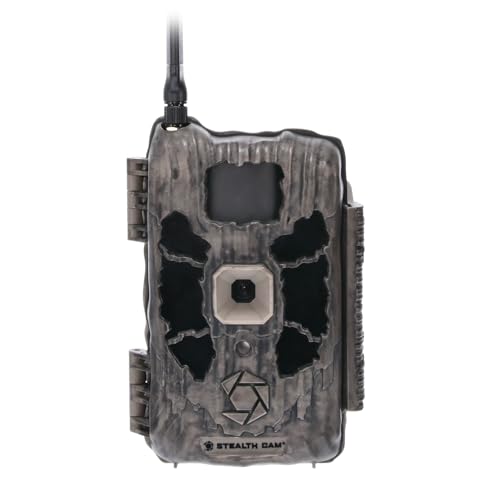
Stealth Cam Deceptor MAX 2.0 No-Glo Dual-Network Cellular Trail Camera
Prices may change · Free shipping with Prime
Design, Build & Theft Resistance
The Deceptor MAX 2.0 is a compact, flat-finished camera designed to disappear against bark, with the covert mission baked into both its name and its look. The case is weatherproof for season-long outdoor use, closing on a positive latch with a gasketed door. It's a tidy unit without an external antenna to snag, and it mounts and aims like any standard trail camera.
The FieldMax power design is the build feature that sets it apart in this price class. Instead of fishing 8 or 16 AAs into the body, you drop in a rechargeable lithium cartridge, which makes battery service faster and cleaner and pairs neatly with solar for long deployments. It's a more modern power approach than the AA trays on cameras like the Tactacam Reveal line, and a genuine convenience over a season.
For theft resistance, the housing accepts a Python-style cable lock through its mounting points, and Stealth Cam offers model-fit security boxes for the Deceptor and G-series cameras for higher-risk sets. Unlike the Tactacam and Moultrie cellular cameras, the Deceptor MAX 2.0 doesn't headline GPS anti-theft tracking, so its physical security leans more on a cable lock and a steel box than on locating a stolen unit. If you're hanging it on public land or a shared lease, plan to harden it with a lockbox; for backyard or owned-property security, a cable lock and the covert flash are usually enough.
Detection & Trigger Speed in the Field
The Deceptor MAX 2.0 triggers in roughly 0.3 to 0.4 seconds, mid-pack for a cellular camera: fast enough for deer working a feeder, scrape, or field edge, but a step behind the 0.2 to 0.3-second flagships on a fast trail crossing. Recovery between frames is reasonable. For the covert scouting this camera is built for, the trigger speed is rarely the limiting factor.
The detection range is the spec to plan around. At 80 feet, it's shorter than the 100-foot Moultrie and Spypoint cameras, and real-world reliable triggering lands closer to 50 to 70 feet. That means placement discipline matters more here: aim it tighter, set it closer to the expected travel, and don't expect it to reach across a wide field edge. On a defined trail, scrape, or feeder at a known distance, the shorter range is a non-issue; on a wide-open set, it's a real limitation.
Imaging punches above the price. The 40MP stills match cameras costing more, though as with most consumer trail cameras, that figure involves interpolation rather than a true 40MP sensor, so temper expectations: the photos are sharp and good for patterning and animal ID, but not flagship-DSLR detailed. The 1440p QHD video is a genuine step above the 1080p competition and useful for confirming behavior, with the usual caveat that video pulls draw harder on your data plan. For a mid-priced covert cellular camera, the image quality is a real strength.
Night Flash: No-Glow vs Low-Glow
Covertness is the Deceptor MAX 2.0's headline feature, and it delivers with a true 940nm no-glow flash driven by a 36-LED array. No-glow means the infrared light is invisible: there's no red glow when the flash fires, so pressured deer never see it light up and a trespasser at night sees nothing. For hunting educated public-land bucks or for security where you don't want to advertise the camera, that genuine stealth is the whole reason to choose this over a low-glow cellular camera.
The trade-off is the same physics every no-glow camera faces: 940nm light is dimmer and reaches shorter than the 850nm low-glow LEDs on cameras like the Spypoint Flex-S or Moultrie Edge 2. You give up some night brightness and reach to gain total invisibility. On the Deceptor MAX 2.0, that physics combines with the already-shorter 80-foot detection range, so night images are best within roughly 40 to 65 feet; beyond that, subjects fall off quickly.
The practical upshot is that this is a camera you place deliberately and relatively close to the action, where its covert flash shines, literally invisibly, on nearby subjects. Within that range the night images are clean and the 36-LED array does a respectable job. If you need the brightest, longest night images for a wide food-plot set and covertness isn't critical, a low-glow camera serves better. Our no-glow vs low-glow guide lays out exactly when the covert flash is worth the range trade-off.
Cellular Data Plans & Real Monthly Cost
The Deceptor MAX 2.0 uses a dual-SIM radio that auto-selects AT&T or Verizon for the stronger link, so one camera works across both networks without you choosing a SIM, useful in country where a single-carrier cam would drop out. On-demand capture lets you trigger a fresh photo from the app, a feature you'd expect from pricier cameras.
Data plans run through Stealth Cam Command, with no-contract monthly tiers starting around $10 a month and scaling by photo count and features. That puts it near the Moultrie Mobile entry point and above Tactacam's roughly $5 annual tier and Spypoint's free 100-photo plan. The plan cost is on you to configure through the Command app rather than being bundled, which fits the slightly more hands-on Stealth Cam experience.
The usual cellular cost trap applies: thumbnails are cheap, but pulling full-resolution images and especially 1440p video on demand draws down your plan allotment faster and can push you into a higher tier. Budget realistically at roughly $120 to $200 a year per camera on a moderate plan, on top of the hardware. Where the Deceptor MAX 2.0 makes its value case is the low hardware price plus rechargeable power, not the plan cost, which is middle-of-the-pack. If minimizing recurring cost is your priority, Spypoint's free tier wins; if you want covert cellular cheaply up front, this is the play. Our cellular data plans guide compares the Stealth Cam Command tiers against the other brands.
Power, Batteries & Cold Weather
The FieldMax power ecosystem is one of the Deceptor MAX 2.0's best features. Rather than feeding it a tray of AAs, you run a FieldMax rechargeable lithium cartridge, which gives long runtime, recharges between trips, and pairs cleanly with solar for season-long deployments. It's a more convenient and, over time, more economical power approach than buying lithium AAs by the dozen for an AA-only camera. The camera also accepts AAs as a fallback if you're caught without the cartridge charged.
If you do run AAs, lithium cells are the right call, not alkalines. Alkalines sag under the current spikes a cellular radio demands and fail fast in the cold, which is when servicing a remote camera is most painful. Energizer Ultimate Lithium AAs hold voltage from roughly -40°F to 140°F and resist that cold-weather sag. But the better answer here is to lean on the FieldMax rechargeable system the camera was designed around.
For true set-and-forget operation, add solar. The Deceptor MAX 2.0 is solar-compatible, and a panel keeping the FieldMax cartridge topped lets it run a full season untouched, the configuration we'd recommend for remote sites. Cold-weather hunters should plan power before the rut, since voltage sag in deep cold is the most common cause of a cellular camera going dark mid-season. Between the rechargeable cartridge and solar, the Deceptor MAX 2.0 gives you good tools to avoid that, just charge the cartridge fully before a cold deployment.
Who Should Buy (And Who Shouldn't)
Buy the Deceptor MAX 2.0 if you want a genuinely covert cellular camera with rechargeable power at a mid-tier price, and the FieldMax ecosystem appeals to you. It's a strong pick for hunters chasing pressured deer who need true no-glow stealth but don't want to pay flagship money, and for anyone who likes the convenience of a rechargeable cartridge plus solar over buying AAs all season. The 40MP and 1440p imaging is a real bonus at this price.
It's a reasonable covert property-security camera too, especially for owned ground where the invisible flash matters and you can secure it with a cable lock and box. The dual-SIM connect keeps it talking across both major carriers.
Skip it if Stealth Cam's historically uneven app and firmware reputation worries you; the hardware is good, but the software experience has frustrated some owners, and a Tactacam or Moultrie offers a more polished app. Skip it if you need long detection range for a wide-open set, where the 80-foot range is a real limitation versus the 100-foot rivals. Skip it if you want GPS anti-theft tracking, which the Tactacam Reveal cameras offer and this one doesn't headline. And skip it if minimizing recurring cost is your goal, where Spypoint's free plan wins. For covert cellular plus rechargeable power on a budget, though, it's a compelling value.
Alternatives Worth Considering
The Tactacam Reveal X-PRO, around $150 to $170, is the covert-cellular rival to weigh most closely. It also runs a true no-glow flash and dual-carrier connect, but adds GPS anti-theft tracking, a more polished and widely trusted app, and a cheaper roughly $5 annual data plan. It's AA-powered rather than rechargeable-cartridge, so it lacks the FieldMax convenience and is hungrier for batteries. If app polish and GPS theft recovery matter more than rechargeable power, the X-PRO is the safer covert pick; the Deceptor undercuts it on price and power convenience.
The Moultrie Edge 2 Pro, around $160, is the step-up for hunters who want maximum reliability and features. It connects across all four carriers rather than two, triggers faster at 0.3 seconds, reaches 100 feet of detection versus the Deceptor's 80, and adds AI false-trigger filtering and onX integration, all with a more mature app. It costs more up front and runs a $9.99 monthly plan with no SD card, but it's the more dependable, longer-reaching camera. Our Spypoint vs Tactacam vs Moultrie showdown covers that decision.
The Spypoint Flex-S, around $200, is the alternative if recurring cost and set-and-forget power are your priorities. Its integrated solar and free 100-photo plan mean years of runtime with no battery swaps and no required subscription, far cheaper over time than Stealth Cam Command. It uses a low-glow flash, so it's less covert than the Deceptor, but for sunny remote scouting where total cost beats stealth, it's the value-minded counterpoint.
Our Verdict
The covert-and-rechargeable mid-tier cell cam: a true no-glow flash plus the FieldMax power ecosystem at a fair price. Worth it if the spotty app track record doesn't scare you.
Stealth Cam Deceptor MAX 2.0 No-Glo Dual-Network Cellular Trail Camera
$117.24
Prices may change · Free shipping with Prime
| Full Specifications | |
|---|---|
| Connectivity | cellular |
| Monthly fee | From ~$10/mo |
| Night flash | no-glow |
| Photo resolution | 40MP |
| Trigger speed | 0.4s |
| Detection range | 80ft |
| Flash range | 80ft |
| Power | Rechargeable lithium (or AA); solar-ready |
| Weather rating | Weatherproof |
| Storage | microSD |
| Video | 1440p |
Frequently Asked Questions
Does it work on Verizon or AT&T?
What does the data plan cost per year?
Will deer or intruders see the flash at night?
How does the FieldMax power system work?
Why is the detection range shorter than rivals?
Is the Stealth Cam app reliable?
Can I lock it to a tree?
Compare With Similar Trail Cameras
Head-to-Head Comparisons
Stealth Cam Deceptor MAX 2.0 No-Glo Dual-Network Cellular Trail Camera
$117.24
Prices may change · Free shipping with Prime