
Moultrie
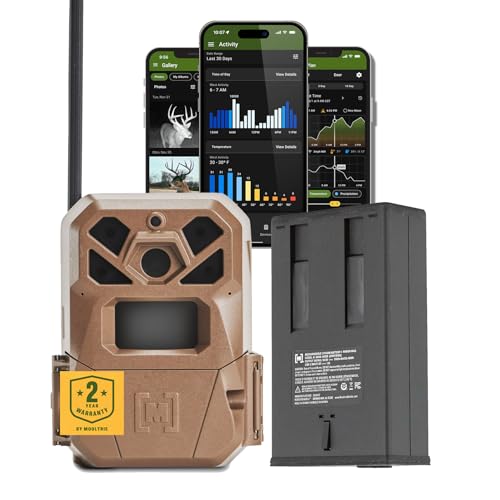
Edge 2
$120
Pros & Cons
Pros
- Same nationwide all-four-carrier auto-connect as the Pro at a friendlier price
- Built-in memory plus onX integration in a clean, beginner-friendly app
- Solar-ready so you can convert it to long-haul power later
- 36MP stills are plenty for scouting and pattern photos
- Easy entry into Moultrie's mature cell ecosystem
Cons
- Low-glow flash gives a faint red glow at night — not fully covert
- Video caps at 1080p versus the Pro's 1440p
- Cloud-tied like the Pro; no SD card backup
At a Glance
Overview
The Moultrie Edge 2 is the value door into one of the most mature cellular ecosystems in the category. Where a lot of mid-priced cell cams are built around a single carrier or a clunky app, the Edge 2 inherits Moultrie Mobile's headline feature: it auto-connects across all four major U.S. carriers, picking whichever network is strongest at the tree without you ever touching a SIM. For anyone who has hung a cellular camera only to find it sitting dark on a dead tower, that nationwide auto-connect is the reason this camera exists.
Priced as the budget sibling to the Edge 2 Pro, the Edge 2 keeps the parts that matter most and trims the parts that cost the most. You get a 36MP still sensor, 1080p video, a roughly 0.4-second trigger, built-in memory instead of an SD card, and tight integration with onX Hunt so your cameras drop right onto the maps you already scout from. What you give up versus the Pro is covertness and resolution: the Edge 2 runs a low-glow flash and caps video at 1080p, where the Pro adds a no-glow flash and 1440p.
The one structural quirk every buyer needs to understand up front is that the Edge 2 has no SD card slot. It writes to built-in memory and lives in the cloud through the app. That keeps the camera simple and tidy, but it also means there is no card to pull as a backup if you lose connection or your subscription lapses. This is a fully app-and-cloud camera, and you should be comfortable with that model before you buy.
This review covers how the Edge 2 actually performs, what Moultrie Mobile really costs once you factor in the required plan, how the low-glow flash and power options behave, and whether the value version makes more sense for you than stepping up to the Pro or stepping out to a no-monthly-fee camera.
Moultrie Edge 2 Cellular Trail Camera (Auto-Connect 4G LTE)
Prices may change · Free shipping with Prime
Design, Build & Theft Resistance
The Edge 2 is a compact, clean cellular camera with no external antenna sticking out, which is part of its appeal: it presents a low, unobtrusive profile on a tree. The housing is weatherproof and built to Moultrie's usual standard, closing with a simple latch and threading onto a strap or mount without fuss. There is no on-camera screen for framing, which is the trade for the small footprint; you confirm your aim and your connection through the Moultrie Mobile app instead, which is genuinely easy once the camera is activated.
Because there is no SD card door and no protruding antenna, the Edge 2 is one of the tidier cameras to mount and one of the less obvious ones to spot at a glance. That low profile is a quiet theft-resistance advantage in itself; a camera nobody notices is a camera nobody steals.
That said, like any sendable cellular camera, the Edge 2 is a target on public or shared land, and you should plan for it. It pairs with Moultrie's mounting accessories and fits security boxes designed for the Edge body, and Moultrie tags your photos with GPS location, which helps with both stand placement and recovery if a camera goes missing. The cloud-only design adds a subtle wrinkle here: because there is no card to pull, a thief gets the camera but not a card full of your photos, since everything you care about already lives in the app. That is cold comfort if the hardware walks off, but it does mean your data is never lost with the device. On any spot you do not control, add a lockbox and treat the GPS tagging as your recovery insurance.
Detection & Trigger Speed in the Field
The Edge 2's roughly 0.4-second trigger is comfortably mid-pack and well matched to how most people use a cellular camera. On a feeder, a food plot, a mineral site, or any spot where deer linger, a 0.4-second trigger fires and frames cleanly. Where it shows its limits is the same place every mid-speed camera does: a tight trail crossing where an animal is moving steadily, where you will occasionally clip the back half of a fast walker. If catching quick movers on narrow trails is your main goal, the Edge 2 Pro's 0.3-second trigger helps a little, and a dedicated fast-trigger SD camera helps more. For scouting and patterning, 0.4 seconds is plenty.
Detection range is rated at 100 feet, and as with every trail camera that number is a best-case lab figure. Real-world PIR detection drops in cold weather and in open, sun-baked settings where the background temperature is close to an animal's body heat. Plan your placement for a reliable trigger zone well inside that 100-foot rating and you will be happier with your hit rate.
The 36MP still sensor is interpolated up from a smaller native sensor, like nearly every camera in the category, so do not read 36 megapixels as 36 megapixels of true detail. In practice it produces sharp, usable daytime photos that are more than enough to identify a specific animal and 1080p video that is solid for a cell cam at this price. Moultrie's AI false-trigger filtering, which is more aggressive on the Pro but present across the Edge line, genuinely earns its keep: by suppressing empty frames from waving branches and heat shimmer, it both cleans up your feed and stretches battery and data life, because the camera is not burning power and uploads on nothing.
Night Flash: No-Glow vs Low-Glow
The Edge 2 uses a low-glow infrared flash, and this is the clearest line between it and the pricier Edge 2 Pro, which steps up to a true no-glow flash. Low-glow LEDs operate around the 850nm wavelength, producing brighter, longer-reaching night images than no-glow at the cost of a faint red glow when the flash fires. A person looking directly at the camera at night will see that glow, and there is a long-running debate among hunters about whether deer notice it. Our no-glow versus low-glow guide breaks down what the evidence actually supports.
For the way most people use a cellular camera, the low-glow flash is the right trade and arguably the better one. On your own land, over a feeder, on a food plot, or watching a driveway or gate, the brighter low-glow night image beats a dimmer no-glow shot, and the faint glow does not matter because you are not trying to hide the camera. You get cleaner, more detailed night photos for it.
The low-glow flash becomes a liability only in two situations: heavily pressured public-land deer that have been educated by hunting activity, and covert security where being detected defeats the purpose. In those cases the Edge 2 Pro's no-glow flash is worth the upgrade. But for the typical Edge 2 buyer scouting their own property, the low-glow flash is not a compromise to apologize for, it is the version that takes better night pictures.
Cellular Data Plans & Real Monthly Cost
The Edge 2 requires a Moultrie Mobile subscription to do anything useful, and unlike Spypoint there is no free tier, so the plan is a non-negotiable part of the cost. Moultrie Mobile plans start at $9.99 a month per camera at the entry tier, with higher tiers raising your monthly image allotment and unlocking more frequent uploads and on-demand control. Owner reviews note that the top tiers climb toward unlimited image plans in the $20-plus range, and that, like most brands, paying annually rather than month-to-month lowers the effective monthly cost. Moultrie also offers multi-camera and fleet pricing, which matters a lot if you are running several cameras across a property, because per-camera plans add up fast.
The honest framing: budget the plan as part of the purchase, every time. A $120 camera on a $9.99 plan is really a $120 camera plus roughly $120 a year, which over three years more than doubles your total cost. That is not a knock on the Edge 2 specifically; it is the reality of every cellular camera, and Moultrie's nationwide all-four-carrier auto-connect is part of what you are paying for. That connection reliability is the Edge 2's strongest argument: in fringe-coverage country where a single-carrier camera goes dark, the Edge 2 grabbing whichever of the four networks is strongest is the difference between photos and a dead camera.
Before you commit, run the cellular data plans math against your actual use. If the connection convenience and onX integration are worth a recurring bill to you, the Edge 2 is a strong, reliable value. If you balk at paying every month forever, this is exactly the moment to compare a no-monthly-fee camera, where you pay more up front but nothing thereafter. One additional note on the cloud-only design: if your subscription lapses, you lose the camera's usefulness entirely, because there is no SD card to fall back on. Keep the plan active or the camera goes quiet.
Power, Batteries & Solar / Cold Weather
The Edge 2 runs on AA batteries, configurable as 8 or 16 cells, and it is solar-ready, which is the path serious owners should plan for. Like every cellular camera, the Edge 2 draws meaningful current every time it uploads, so battery life is a direct function of how much traffic your spot sees and how often the camera is transmitting. A busy feeder camera on frequent uploads will eat batteries far faster than a quiet camera checking in a few times a day. Moultrie's AI false-trigger filtering helps here by cutting wasted uploads on empty frames, which genuinely extends runtime, but power management is still on you.
The first and cheapest upgrade is chemistry: run lithium AAs instead of alkaline. Lithium delivers two to three times the runtime, weighs less, and holds steady voltage in the cold, which alkaline does not. In freezing weather alkaline voltage sags badly and a camera with plenty of life left will falsely report dead; lithium AAs largely eliminate that cold-snap failure, and since the best deer movement often coincides with the coldest weather, that reliability is not optional in northern climates.
The better long-haul solution is solar. Because the Edge 2 is solar-ready, you can run a compatible panel to keep it fed through the season and turn it into a near set-and-forget camera, provided it gets real sun. Deep north-facing canopy will starve any solar setup, especially in winter when short days and low sun angles cut charging, so place the camera or the panel where it gets sky. Run the Edge 2 on lithium AAs at minimum, add solar for any remote spot you hate revisiting, and the power side of the camera takes care of itself.
Who Should Buy (And Who Shouldn't)
Buy the Edge 2 if you want the most reliable cellular connection in the mid-tier and you live in onX Hunt. The all-four-carrier auto-connect is the real reason to choose Moultrie over rivals locked to one or two networks, and in fringe-coverage country it is genuinely the difference between a working camera and a dead one. The onX integration that drops your cameras onto your hunting maps is a meaningful workflow win for hunters who already scout digitally, and the clean, beginner-friendly app makes this a great first cellular camera. At its mid-tier price it is the value entry into a mature, well-supported ecosystem.
Do not buy the Edge 2 if you need covert performance on pressured deer; step up to the no-glow Edge 2 Pro instead. Skip it if you specifically want higher-resolution video, since it caps at 1080p where the Pro shoots 1440p. Be honest with yourself about the cloud-only, no-SD design: if the idea of having no card to pull as a backup bothers you, or if there is any chance you will let the subscription lapse, this camera will frustrate you, because without an active plan and a connection it has nothing to fall back on. And as with any cellular camera, if a recurring monthly bill is a dealbreaker, a no-monthly-fee WiFi or SD camera will cost more up front and nothing after, which over three years can come out well ahead.
Alternatives Worth Considering
The most direct alternative is the camera right above it in the lineup: the Moultrie Edge 2 Pro. For a step up in price you keep the identical nationwide all-four-carrier auto-connect and onX integration, and you add a true no-glow flash for covert use, a 40MP sensor, a faster 0.3-second trigger, and 1440p video. If covertness or image quality matter to you and you are already sold on the Moultrie ecosystem, the Pro is the obvious upgrade and the better long-term buy for serious hunters.
If the appeal of cellular is real but the recurring fee is the sticking point, the Spypoint Flex-M is worth a hard look. It is the only major brand with a genuinely free plan, sending 100 photos a month at no cost forever, with dual-SIM auto-carrier connection and AI species filtering. It trades down to 720p video and a hungrier appetite for batteries, but for a once-a-week scouter the free plan can make it far cheaper to own over three years.
Finally, if you want to escape monthly fees entirely, look at a no-monthly-fee camera like the GardePro E8 2.0, which shoots 4K with a fast 0.1-second trigger and pulls photos to your phone over local WiFi for zero ongoing cost. The catch is that WiFi means you must be near the camera to retrieve images, with no off-site checking, so it suits backyard and near-stand use rather than remote scouting. Our brand showdown and cellular data plans guides walk through exactly when the Edge 2's connection reliability is worth the bill and when a no-fee camera serves you better.
Our Verdict
The value door into Moultrie Mobile: you keep the reliable nationwide connection and onX integration, trading covertness and resolution for a lower price. Great first cell cam.
Moultrie Edge 2 Cellular Trail Camera (Auto-Connect 4G LTE)
$120
Prices may change · Free shipping with Prime
| Full Specifications | |
|---|---|
| Connectivity | cellular |
| Monthly fee | From $9.99/mo |
| Night flash | low-glow |
| Photo resolution | 36MP |
| Trigger speed | 0.4s |
| Detection range | 100ft |
| Flash range | 80ft |
| Power | 8/16x AA; solar-ready |
| Weather rating | Weatherproof |
| Storage | Built-in memory |
| Video | 1080p |
Frequently Asked Questions
Does the Moultrie Edge 2 need a subscription to work?
What does the Moultrie Mobile plan cost?
Which carriers does the Edge 2 use?
Is there an SD card backup?
Is the flash visible at night?
How long do the batteries last?
Does solar work in winter?
How is the Edge 2 different from the Edge 2 Pro?
Related Buying Guides
Compare With Similar Trail Cameras
Spypoint
Flex-M
cellular · Free tier (100 photos); from $10/mo · low-glow
$259.98
Head-to-Head Comparisons
Moultrie Edge 2 Cellular Trail Camera (Auto-Connect 4G LTE)
$120
Prices may change · Free shipping with Prime