
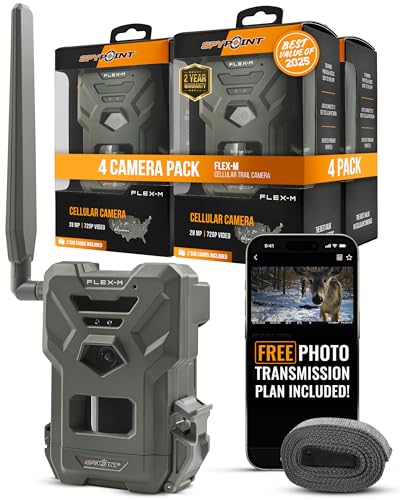
Spypoint
Flex-M
$259.98
Pros & Cons
Pros
- Only major brand with a genuinely free plan — 100 photos a month at no cost, forever
- Dual-SIM auto-carrier picks the best network so you're not locked to one tower
- Buck Tracker AI filters by species so your feed isn't 400 squirrel photos
- GPS location tagging built in for theft recovery and stand placement
- 28MP stills look sharp for a mid-priced cell cam
Cons
- AA battery life is weak — plan on the LIT-22 pack or a solar setup
- Video tops out at 720p, behind newer rivals
- Free tier fills up fast on a busy trail; you'll likely upgrade a plan
At a Glance
Overview
The Spypoint Flex-M earns its spot in the cellular conversation for one reason almost nobody else can match: a genuinely free plan. Spypoint will send you 100 photos a month, every month, at no cost, for as long as you own the camera. In a category where the recurring data fee usually costs more over three years than the camera itself, that free tier is the single most important thing to understand about this camera before you decide whether the rest of the package fits you.
Underneath the marketing, the Flex-M is a mid-priced dual-SIM LTE camera built around a 28MP still sensor, a roughly 0.4-second trigger, and a low-glow infrared flash. It auto-selects between carriers on its two SIMs so you are not betting your season on a single tower, and it leans on Spypoint's Buck Tracker AI to sort your feed by species instead of burying a buck photo under 400 squirrel triggers. None of those features are class-leading on their own, but bundled at this price with a free plan, the value math gets interesting fast.
The honest catch is power. The Flex-M's AA appetite is real, and anyone who hangs it on eight alkalines and walks away is going to be disappointed by how quickly it taps out, especially once it is uploading photos over LTE in cold weather. This is a camera you should plan to feed with lithium AAs, the LIT-22 rechargeable pack, or a solar setup from day one. Budget for that and the value holds; ignore it and you will be hiking back to a dead camera.
This review walks through how the Flex-M actually behaves in the field, what the data plans really cost once you outgrow the free tier, and who should buy it versus who should look at a no-monthly-fee camera or a step up to a more covert no-glow body.
Spypoint Flex-M Cellular Trail Camera (Dual-SIM LTE)
Prices may change · Free shipping with Prime
Design, Build & Theft Resistance
The Flex-M is a compact, traditional box-style cellular camera with an IP65 weatherproof rating, which in plain terms means it shrugs off rain, dust, and the kind of weather a camera lives in for a full season. The housing is unremarkable in the best way: it closes with a simple latch, the antenna threads on, and there is nothing fragile about how it goes together. After a few months on a tree it will be faded and a little grimy, but that is true of every camera in this class.
Mounting is standard strap-and-tree, with a quarter-inch tripod thread on the back if you prefer a mount or a stake. There is a built-in screen for confirming your aim and your signal bars on-site, which matters more than it sounds. Hanging a cell cam without confirming it actually has a connection where you mounted it is how people end up with a camera that never sends a single photo.
Theft resistance is where every cellular owner needs a plan, and the Flex-M is no exception. It is a desirable, sendable camera, which makes it a target on public or shared land. The body accepts a Python-style cable lock through the housing, and it fits common steel security boxes designed for Spypoint Flex bodies. Spypoint also tags photos with GPS location data, which is a genuine help for recovery if a camera walks off. None of that stops a determined thief with tools, but a lockbox plus a cable plus location tagging removes the easy grab-and-go theft that accounts for most losses. If this camera is going anywhere you do not control, treat a security box as part of the purchase, not an optional extra.
Detection & Trigger Speed in the Field
The Flex-M's roughly 0.4-second trigger is solidly mid-pack. It is fast enough for a deer working a scrape, a food plot, or a feeder, where animals linger and the camera has time to fire and frame. Where a 0.4-second trigger starts to show its limits is on a tight trail crossing where a buck is moving at a steady walk; you will occasionally get a tail or a back half instead of a full broadside. If catching fast movers on narrow trails is your priority, a 0.1-second budget camera or a premium 0.2-second body will simply miss less, and that is an honest trade you make for the cellular convenience here.
Detection range lands around 90 feet, which is realistic rather than optimistic. Trail-cam detection numbers are notoriously inflated across the industry because they are measured under ideal lab conditions; in cold weather, when the temperature difference between an animal and its background shrinks, real-world detection on any PIR camera drops. Plan your placement for 40 to 60 feet of reliable trigger zone and you will be happier than if you trust the spec sheet to the foot.
On image quality, the 28MP still figure deserves the standard caveat that applies to nearly every trail camera: the megapixel number is interpolated up from a smaller native sensor. Twenty-eight megapixels does not mean twenty-eight megapixels of real detail. What you get in practice is a sharp, usable daytime photo that is plenty for patterning and identifying a specific animal, and a perfectly serviceable night image within flash range. Video tops out at 720p, which is the Flex-M's clearest weakness on paper; newer rivals shoot 1080p and beyond. For a scouting camera whose job is to tell you what is using a spot and when, 720p video is acceptable, but if you care about clip quality this is not your camera. Buck Tracker AI species filtering is the quiet standout here, sorting your feed so you spend less time scrolling past raccoons and more time looking at deer.
Night Flash: No-Glow vs Low-Glow
The Flex-M uses a low-glow infrared flash, and you should understand exactly what that means before you hang it in front of pressured deer. Low-glow LEDs typically operate around the 850nm wavelength, which produces brighter, longer-reaching night photos than a true no-glow flash. The trade-off is that an 850nm emitter array gives off a faint red glow when it fires. A human looking directly at the camera at night will see it, and there is long-running debate among hunters about whether deer notice and react to it. Our no-glow versus low-glow guide digs into what the evidence actually supports, but the short version is this: the glow is real, it is faint, and how much it matters depends entirely on your situation.
For most uses, the low-glow flash is a non-issue and even an advantage. On your own land, on a food plot, watching a feeder, or running security on a driveway where you do not care if the camera is visible, the brighter low-glow image is the better outcome. The faint glow also helps confirm at a glance that the camera fired.
Where low-glow becomes a liability is heavily pressured public-land deer and any situation where being detected defeats the purpose. A mature buck that has been educated by hunting pressure, or a trespasser you are trying to document without tipping off, are the cases where you want a true 940nm no-glow flash instead. If covertness is your top priority, the Flex-M is the wrong tool, and you should look at a no-glow body. For the majority of hunters and property owners, the low-glow flash on the Flex-M is the right call and produces better night images for it.
Cellular Data Plans & Real Monthly Cost
This is the section that decides whether the Flex-M is right for you, because the plan is half the product. The headline is the free tier: Spypoint sends 100 photos per month at no charge, forever, with no card on file required. For a low-traffic camera on a quiet spot, 100 photos a month is genuinely enough to stay informed, and you can run the Flex-M for years without paying a cent in data fees. No other major brand offers anything close to that.
The practical catch is that 100 photos fills up fast on a busy trail. A camera over a feeder or on an active food plot can blow through 100 triggers in a few days, and once you hit the cap you stop receiving photos until the next month resets. That is the moment most owners upgrade. Spypoint's paid plans run roughly $5 a month at the low end up to around $15 to $20 a month for the top tier, with the higher tiers raising your monthly photo allotment and unlocking HD photo and video transmission. Owner reviews consistently note that paying annually rather than monthly knocks the effective cost down meaningfully, so if you know you are keeping the camera a full season, the annual billing is the smarter buy.
The honest budgeting advice: do not evaluate this camera on its sticker price alone. Run the cellular data plans math for your actual usage. If you are a once-a-week scouter on a quiet spot, the free tier may carry you indefinitely and the Flex-M becomes one of the cheapest cellular cameras to own over three years. If you are watching a high-traffic spot and want video, you will land on a paid tier, and at that point you should compare the three-year total against a no-monthly-fee WiFi or SD camera. Note also that the dual-SIM hardware auto-selects between carriers for the stronger signal, which is a real reliability advantage in spotty country, but the plan you pay for is separate from which tower the camera grabs.
Power, Batteries & Solar / Cold Weather
Power is the Flex-M's defining weakness, and it is fixable, but only if you address it on purpose. The camera runs on eight AA batteries, and on standard alkalines it does not last long, particularly once it is transmitting photos over LTE. Every cellular upload draws meaningful current, so a busy camera on a paid plan is also a camera burning through cells faster than a non-connected SD camera ever would. Owners who hang it on the alkalines that came out of the junk drawer are the ones who write the disappointed reviews.
The first fix is chemistry: run lithium AAs, not alkaline. Lithium cells deliver two to three times the runtime, weigh less, and, critically, hold steady voltage in the cold instead of sagging and triggering false low-battery warnings. In cold weather this is not a luxury; alkaline voltage drops sharply below freezing, and a camera that should have weeks of life left will report dead in a January cold snap. Lithium AAs largely solve that.
The better long-term fix is to get off AAs entirely. The Flex-M accepts Spypoint's LIT-22 rechargeable battery pack, which both extends runtime and lets you top off between trips, and it pairs with solar to approach set-and-forget operation. A solar panel keeps the pack charged through the season as long as the camera gets real sun; deep north-facing canopy will starve any solar setup, so give the panel sky. If you want the integrated-solar experience without bolting on accessories, Spypoint's own Flex-S builds the solar panel and rechargeable pack into the body, and for a remote camera you hate revisiting that is often the smarter buy. Budget for lithium, a rechargeable pack, or solar with the Flex-M and the power complaint disappears.
Who Should Buy (And Who Shouldn't)
Buy the Flex-M if you want to try cellular scouting without committing to a recurring bill. The free 100-photo plan makes this the lowest-risk on-ramp to cell cameras on the market: you can hang it on a quiet spot, see real photos on your phone, and decide whether the convenience is worth paying for before you ever open your wallet for data. For a once-a-week scouter on their own land or a small property, that is a genuinely smart value play, and the dual-SIM auto-carrier feature means it will stay connected in places a single-carrier camera would go dark. The Buck Tracker species filtering is a nice quality-of-life bonus that keeps your feed readable.
Do not buy the Flex-M if you need covert performance on pressured deer; the low-glow flash is the wrong tool and a true no-glow body is what you want. Skip it if video quality matters to you, because 720p is behind the field. And think twice if you are unwilling to invest in better power, because the AA appetite is the one complaint that turns into a dead camera if you ignore it. Finally, if your spot is high-traffic enough that you will immediately outgrow the free tier and land on a paid plan, run the three-year total cost against a no-monthly-fee camera before you commit; the free plan is the Flex-M's whole argument, and if you are not going to use it, a no-fee WiFi or SD camera may serve you better and cheaper.
Alternatives Worth Considering
If the Flex-M's power story bothers you but you love the free Spypoint plan, the Spypoint Flex-S is the obvious step up. It builds an integrated solar panel and rechargeable battery into the body, bumps the still sensor to 36MP, adds 1080p video with sound, and keeps the same free 100-photo plan and dual-SIM auto-connect. You pay a premium for the never-swap-batteries convenience, but for a remote camera it is the true set-and-forget version of what the Flex-M is trying to be.
If covertness is your priority and you can live without the free tier, the Stealth Cam Deceptor MAX 2.0 brings a true 940nm no-glow flash, a rechargeable lithium FieldMax cartridge, dual-network auto-connect, and 40MP stills with 1440p video at a similar mid-tier price. Its weak spots are a shorter 80-foot detection range and a historically uneven app, but on pure covert performance it is a tier above the low-glow Flex-M.
Finally, if the recurring-fee model is the real sticking point, step out of cellular entirely and look at a no-monthly-fee camera like the GardePro E8 2.0, which shoots 4K with a fast trigger and pulls photos to your phone over local WiFi for zero ongoing cost. The catch is range: WiFi means you have to be near the camera to pull images, with no off-site checking. Our brand showdown and no monthly fee guides lay out exactly when the cellular convenience is worth the bill and when it is not.
Our Verdict
The smart value entry into cellular: the free 100-photo plan lets you try cell scouting with zero recurring cost. Just buy the rechargeable pack or solar — the AA appetite is the real catch.
Spypoint Flex-M Cellular Trail Camera (Dual-SIM LTE)
$259.98
Prices may change · Free shipping with Prime
| Full Specifications | |
|---|---|
| Connectivity | cellular |
| Monthly fee | Free tier (100 photos); from $10/mo |
| Night flash | low-glow |
| Photo resolution | 28MP |
| Trigger speed | 0.4s |
| Detection range | 90ft |
| Flash range | 80ft |
| Power | 8x AA (or LIT-22 pack) |
| Weather rating | IP65 |
| Storage | microSD |
| Video | 720p |
Frequently Asked Questions
Is the Spypoint Flex-M's free plan really free forever?
What do the paid data plans cost if I outgrow the free tier?
Which carrier does the Flex-M use?
Is the low-glow flash visible at night?
How long does the battery last?
Does solar work on the Flex-M in winter?
Why is the video only 720p?
Can I lock the Flex-M against theft?
Related Buying Guides
Compare With Similar Trail Cameras
Head-to-Head Comparisons
Spypoint Flex-M Cellular Trail Camera (Dual-SIM LTE)
$259.98
Prices may change · Free shipping with Prime