
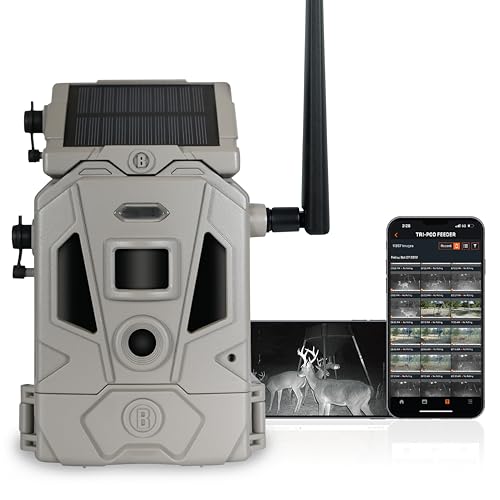
Bushnell
CelluCORE 20 Solar
$130
Pros & Cons
Pros
- Detachable solar panel on a cable lets you mount the panel in the sun and the camera in the shade
- Easily 6+ months of runtime once the solar keeps the internal battery topped
- Dual-SIM AT&T/Verizon auto-connect from a brand people already trust for optics
- Reliable, clean picture quality day and night
- No-contract plans at $9.99 and $14.99/mo
Cons
- Only 20MP and 1080p — resolution lags the 36–40MP rivals
- Trigger speed is mid-pack, not a fast-action cam
- Low-glow flash, so a faint glow is visible at night
At a Glance
Overview
The Bushnell CelluCORE 20 Solar is built around one genuinely clever idea that most solar trail cameras get wrong: the solar panel detaches. Instead of bolting the panel to the top of the camera body, where the camera's ideal aiming position and the panel's ideal sun position almost never line up, Bushnell puts the panel on a cable so you can mount the camera in the shade pointed at your trail and stake the panel out in the sun. That single design choice solves the most common frustration with integrated-solar cameras, and it is the main reason this camera is worth talking about.
Underneath that trick, the CelluCORE 20 is a sensible mid-priced cellular camera from a brand most people already trust for optics and binoculars. It runs dual-SIM auto-connect across AT&T and Verizon so it grabs the stronger network on its own, delivers clean and reliable day and night images, and pairs an internal battery with the detachable solar panel for runtime measured in months rather than weeks. Owner reviews consistently report 6-plus months of unattended operation once the solar keeps the internal battery topped, which is the whole point.
Where the CelluCORE 20 asks you to compromise is resolution. Its 20MP sensor and 1080p video lag the 36 to 40MP rivals in this price range, and its trigger speed is mid-pack rather than fast. This is not a megapixel-race camera or a fast-action camera; it is a dependable, low-maintenance camera that you hang once and largely forget. If headline specs are what you shop on, you will be tempted by flashier numbers elsewhere. If long unattended runtime and connection reliability are what you actually need, the CelluCORE 20 makes a strong, quiet case.
This review covers how the detachable solar system really works, what the dual-SIM connection and data plans cost, where the 20MP sensor holds the camera back, and whether it is the right low-maintenance cell cam for you or whether a higher-resolution rival fits better.
Bushnell CelluCORE 20 Solar Cellular Trail Camera (Detachable Solar, Dual-SIM)
Prices may change · Free shipping with Prime
Design, Build & Theft Resistance
The CelluCORE 20 Solar comes in two parts that work as a system: the camera body and the detachable solar panel that connects by cable. The body is a compact, weatherproof box camera with Bushnell's typical no-nonsense build quality, closing with a simple latch and threading onto a strap or mount in the usual way. The detachable panel is the standout, mounting separately and running power back to the camera through a weatherproof cable so you can position each piece independently. In the field this means you are never forced to choose between aiming the camera correctly and aiming the panel at the sun, which is the compromise every fixed-panel solar camera makes.
Build quality is solid and the picture quality, day and night, is clean and consistent, which is what you expect from Bushnell. There is no flashy on-camera screen drama here; this is a workmanlike camera designed to be reliable rather than feature-dense.
Theft resistance deserves real thought with this camera, more than usual, because the detachable panel adds a second piece that can be stolen or cut loose. The body fits common security boxes and accepts cable locks, and the dual-SIM cellular connection means the camera is sending photos to your phone regardless, but the exposed panel and its cable are vulnerable on public or shared land. If you are running this in a spot you do not control, plan to secure both the camera and the panel, route the cable to make it hard to grab, and consider whether the detachable design is worth the added theft surface in your specific situation. On your own property, where security is less of a concern, the detachable panel is pure upside.
Detection & Trigger Speed in the Field
The CelluCORE 20's trigger speed is around half a second, which puts it at the slower end of mid-pack. That is the honest weak point of this camera for action shots. On a feeder, a food plot, a bait site, or any spot where animals stop and linger, a half-second trigger fires and frames fine. On a tight trail crossing where a deer is moving at a steady walk, you will miss more than you would with a faster camera, sometimes catching only a tail or an empty frame as the animal clears. This is not the camera for narrow, fast-action trails; aim it at spots where animals pause.
Detection range is rated around 80 feet, which is shorter than the 100-foot rivals in this class, so placement matters more. As with every PIR trail camera, the rated range is a best-case figure that drops in cold weather and in open settings where background and body temperatures are close. Aim the CelluCORE 20 at a tighter, closer trigger zone than you might a longer-range camera and you will get a better hit rate. Because its detection cone is shorter, this camera rewards thoughtful placement closer to the action.
The 20MP sensor is the clearest spec compromise. It is interpolated like every trail-cam sensor, but even setting that aside, 20MP and 1080p video genuinely trail the 36 to 40MP, 1440p-and-up competition at this price. What that means in practice is not that the photos are bad, they are clean, reliable, and perfectly usable for identifying animals and patterning, but that you will not be cropping in tight or printing wall photos from them. Day and night image quality is dependable and consistent, which is arguably more valuable than raw resolution for a scouting camera. Just go in understanding this is a reliability-first camera, not an image-quality leader.
Night Flash: No-Glow vs Low-Glow
The CelluCORE 20 uses a low-glow infrared flash, which produces brighter, longer-reaching night images at the cost of a faint visible red glow when it fires. Low-glow LEDs operate around the 850nm wavelength; a person looking directly at the camera at night will see the dim glow, and there is an ongoing debate among hunters about whether deer notice and react to it. Our no-glow versus low-glow guide lays out what the evidence actually supports.
For the way most people will use this camera, the low-glow flash is the right trade. The CelluCORE 20 is a low-maintenance, set-and-forget camera, and most owners hang it on their own land, on a feeder, a field edge, or a property line for security, where the camera being faintly visible at night simply does not matter. In those settings the brighter low-glow night image is the better outcome, giving you cleaner, more detailed photos in the dark.
The low-glow flash only becomes a liability if you are running the camera on heavily pressured public-land deer or doing covert surveillance where being detected defeats the purpose. In those cases you want a true 940nm no-glow flash, and the CelluCORE 20 is not the camera for it. But given that this camera's whole identity is dependable long-haul operation rather than covert deer hunting, the low-glow flash fits its mission. Buy it knowing the glow is there and faint, and for most users it will never be a problem.
Cellular Data Plans & Real Monthly Cost
The CelluCORE 20 uses dual-SIM auto-connect, carrying both AT&T and Verizon SIMs and selecting whichever network is stronger at your tree, with no manual SIM swapping. That dual-carrier hardware is a real reliability advantage over single-carrier cameras, because in fringe-coverage country your odds of holding a usable connection roughly double when the camera can choose between two major networks.
The data plans are no-contract Bushnell plans that owners report at roughly $9.99 and $14.99 a month for the main tiers, with the higher tier raising your monthly photo allotment and upload frequency. There is no free tier here the way Spypoint offers, so the plan is a required, ongoing cost rather than an optional extra. As with every cellular camera, paying annually rather than month-to-month typically lowers the effective monthly cost, so commit to annual billing if you plan to keep the camera running a full season or more.
The budgeting reality is the same as for any cell cam: do not judge this camera on its sticker price alone. A $130 camera on a roughly $120-a-year plan is, over three years, closer to a $490 commitment. That is not unique to Bushnell, it is the structural cost of cellular, and the dual-SIM connection reliability and the long solar-powered runtime are part of what you are buying. Run the cellular data plans math for your actual usage before you commit. If the convenience of photos to your phone from a remote spot you rarely visit is worth a recurring bill, the CelluCORE 20 is a dependable choice. If the monthly fee is a dealbreaker, this is the moment to compare a no-monthly-fee camera that costs more up front and nothing after.
Power, Batteries & Solar / Cold Weather
Power is the CelluCORE 20's strongest argument, and the detachable solar panel is the reason. The camera runs an internal battery that the panel keeps topped, and because the panel mounts separately on a cable, you can chase the sun without compromising the camera's aim. This is the key advantage over integrated-solar cameras, where the panel is locked to the camera's position and ends up shaded under the same canopy you wanted the camera hidden in. With the CelluCORE 20 you put the camera in the shade on your trail and the panel out in a sunny gap, and the system keeps itself fed. Owners routinely report 6-plus months of unattended runtime once the solar is doing its job, which is the entire point of buying this camera.
The winter caveat applies here as it does to all solar. Short days, low sun angles, and snow on the panel all cut charging in the coldest months, exactly when you may not want to make a battery trip. The internal battery acts as a buffer through cloudy and short-day stretches, and the detachable panel actually helps in winter too, because you can position it for the best available low-angle sun rather than being stuck with a fixed top-mounted panel under a tree. Still, in deep winter in northern climates, expect the solar to keep pace rather than fully replenish, and check the camera's battery level through the app so a long cold cloudy spell does not catch you off guard.
For the most reliable cold-weather operation, give the panel the clearest sky you can and clear snow off it when you visit. The detachable design gives you more flexibility to manage all of this than any fixed-panel competitor, which is why the CelluCORE 20 earns its low-maintenance reputation.
Who Should Buy (And Who Shouldn't)
Buy the CelluCORE 20 Solar if low maintenance and connection reliability matter more to you than headline specs. The detachable solar panel is a genuinely better solution than fixed integrated solar, letting you put the camera where it should go and the panel where the sun is, which is why owners get months of unattended runtime. Paired with dual-SIM AT&T and Verizon auto-connect and Bushnell's dependable image quality, it is an excellent choice for a remote spot you hate revisiting, a property-line security camera, or anyone who values a camera that just keeps working over one that brags on the box. The brand pedigree is real; Bushnell knows optics, and the picture quality reflects it.
Do not buy the CelluCORE 20 if resolution is your priority. At 20MP and 1080p it genuinely trails the 36 to 40MP, 1440p rivals at this price, and if you want to crop in tight or shoot high-quality video, you will be happier elsewhere. Skip it for fast-action trail crossings, because the roughly half-second trigger and shorter 80-foot detection range mean it misses more quick movers than faster cameras. And as with every cellular camera, if a recurring monthly fee is a dealbreaker, a no-monthly-fee camera will serve you better over the long run. Finally, weigh the theft exposure of the detachable panel honestly if the camera is going on land you do not control; on your own property it is pure upside, but on public land the extra piece is an extra thing to lose.
Alternatives Worth Considering
If you love the idea of solar-powered cellular but want the panel built in rather than detachable, the Spypoint Flex-S is the natural comparison. It integrates the solar panel and rechargeable battery into the body, bumps resolution to 36MP with 1080p sound video, and adds Spypoint's free 100-photo plan so the recurring cost can stay optional. The trade is that its fixed panel cannot chase the sun the way the CelluCORE 20's detachable panel can, so placement is less flexible, but the higher resolution and free plan are real advantages.
If you want the same dual-SIM, solar-capable approach but with covert performance and higher resolution, the Stealth Cam Deceptor MAX 2.0 brings a true 940nm no-glow flash, 40MP stills, 1440p video, and a rechargeable lithium power system at a similar price. It is the higher-spec, more covert option; its weak points are a shorter detection range and a historically uneven app, but on raw capability it outclasses the 20MP CelluCORE.
If the recurring fee is the real obstacle, step out of cellular and consider a no-monthly-fee camera. The GardePro E8 2.0 shoots 4K with a fast trigger and pulls photos over local WiFi for zero ongoing cost, and you can add a universal solar panel to get the same set-and-forget power without ever paying for data. The catch is WiFi range, which means you must be near the camera to retrieve images. Our no monthly fee and brand showdown guides cover exactly when the CelluCORE's cellular convenience justifies the bill and when a no-fee setup wins.
Our Verdict
The detachable-solar trick is the real reason to buy: you can chase the sun without moving the camera. A dependable, low-maintenance cell cam if you don't need headline megapixels.
Bushnell CelluCORE 20 Solar Cellular Trail Camera (Detachable Solar, Dual-SIM)
$130
Prices may change · Free shipping with Prime
| Full Specifications | |
|---|---|
| Connectivity | cellular |
| Monthly fee | From $9.99/mo |
| Night flash | low-glow |
| Photo resolution | 20MP |
| Trigger speed | 0.5s |
| Detection range | 80ft |
| Flash range | 80ft |
| Power | Internal + detachable solar |
| Weather rating | Weatherproof |
| Storage | microSD |
| Video | 1080p |
Frequently Asked Questions
How does the detachable solar panel actually help?
What do the data plans cost?
Which carriers does it use?
Does the solar work in winter?
Is the 20MP sensor a dealbreaker?
Is the flash visible at night?
How long does it run on a charge?
Can I secure both the camera and the panel against theft?
Related Buying Guides
Compare With Similar Trail Cameras
Spypoint
Flex-M
cellular · Free tier (100 photos); from $10/mo · low-glow
$259.98
Spypoint
Link-Micro-S-LTE
cellular · Free tier (100 photos); from $10/mo · low-glow
$140
Head-to-Head Comparisons
Bushnell CelluCORE 20 Solar Cellular Trail Camera (Detachable Solar, Dual-SIM)
$130
Prices may change · Free shipping with Prime