
Spypoint
Link-Micro-S-LTE
$140
Pros & Cons
Pros
- Tiny footprint hides easily on a scrape line or near a feeder
- Integrated solar plus the LIT-10 rechargeable battery give very long runtime
- Same free 100-photo Spypoint plan keeps recurring cost optional
- Dead-simple setup — a good first cellular camera
- Compact enough to run several across a property without the bulk
Cons
- Only 10MP stills — fine for scouting, not for framing wall photos
- Small detection zone; you must place it close to the trail
- No real video on the free tier
At a Glance
Overview
The Spypoint Link-Micro-S-LTE is the smallest, lowest-maintenance way into cellular scouting, and that compact, set-and-forget identity is the whole reason to consider it. This is not the camera you buy for image quality or for a single trophy spot. It is the camera you buy when you want photos appearing on your phone from several spots across a property without ever swapping batteries or pulling cards, all on a footprint small enough to tuck onto a scrape line or hide near a feeder.
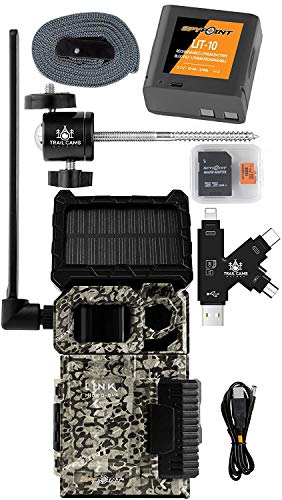
The Link-Micro-S-LTE pairs an integrated solar panel with Spypoint's LIT-10 rechargeable battery, which together give it genuinely long runtime, and it rides on Spypoint's signature free 100-photo plan, so the recurring data cost is optional rather than mandatory. Add in dead-simple setup and a tiny body, and you have a camera built specifically for running multiple low-fuss cellular cameras at once instead of one expensive flagship.
The honest ceiling is the sensor. At 10MP stills with no real video on the free tier, this is the lowest-resolution camera in our cellular lineup, and that is by design rather than by accident. It exists to tell you what is using a spot and when, not to produce wall-worthy photos or detailed video clips. Owner reviews are clear and consistent on this: people who buy it expecting flagship image quality are disappointed, and people who buy it for set-and-forget photo presence on multiple spots are happy. Knowing which camp you are in before you buy is the single most important thing.
This review covers how the Link-Micro-S-LTE actually performs as a compact scouting tool, how the free plan and paid tiers really work, how the integrated solar and LIT-10 power system holds up including in cold weather, and whether its honest 10MP ceiling fits what you need.
Spypoint Link-Micro-S-LTE Solar Cellular Trail Camera (LIT-10 + Solar)
Prices may change · Free shipping with Prime
Design, Build & Theft Resistance
The defining feature of the Link-Micro-S-LTE is its size. This is a genuinely small cellular camera, compact enough to hide where a bulkier camera would be obvious, which makes it easy to tuck onto a scrape line, near a feeder, or low on a tree where it blends in. That small footprint is the camera's signature, and it is what makes running several of them across a property practical: they do not draw attention, and they do not demand the kind of placement real estate a big box camera does. The integrated solar panel sits on top of the body, so the whole package is self-contained with nothing to mount separately.
The build is weatherproof and straightforward, with a simple closure and strap mounting. There is no on-camera screen; you set it up and confirm its operation through the Spypoint app, which is part of what makes it so simple to deploy. For a first cellular camera, the dead-simple setup is a real selling point.
Theft is the usual cellular consideration, with a small twist in this camera's favor: because it is so small and unobtrusive, it is genuinely harder to spot than a larger camera, and a camera nobody notices is a camera nobody steals. That low-visibility advantage is real. Still, on public or shared land you should secure it; smaller security boxes and cable locks exist for the Link-Micro form factor, and Spypoint tags photos with GPS data to aid recovery. Because these cameras are cheap enough to run several, the loss of any one stings less than losing a flagship, but a lockbox on any spot you do not control is still smart insurance.
Detection & Trigger Speed in the Field
The Link-Micro-S-LTE has a roughly 0.4-second trigger, which is fine for the kind of spots this camera is built for. On a scrape, a feeder, a mineral site, or any place an animal pauses, a 0.4-second trigger captures what you need. This was never designed as a fast-action camera for tight trail crossings, and you should not buy it expecting to freeze a buck mid-stride on a narrow trail. Matched to lingering spots, the trigger does its job.
Detection range is the bigger placement consideration. At around 80 feet rated, and with a small detection zone in practice, this camera demands closer, more deliberate placement than a longer-range camera. You must put it near the trail or the activity, not across a wide field hoping to catch movement at distance. Owner reviews repeatedly note the small detection zone, and the cameras that disappoint are usually the ones hung too far from the action. Place it close, aim it at a specific spot where you know animals will be, and it performs as intended. Treat it as a precise, short-range tool rather than a wide-area scanner.
Image quality is the honest ceiling, and it is worth being blunt about. The 10MP sensor produces photos that are fine for scouting, identifying that a buck is using a spot, seeing how many does are around, knowing what time the activity happens, but not for detailed identification, cropping, or anything you would frame. There is no real video on the free tier, so if video matters to you this is immediately the wrong camera. The 10MP stills are the lowest resolution in our cellular lineup, and that is a deliberate trade for the small size, low price, and long runtime. If you go in expecting a scouting tool rather than a photography tool, the image quality is exactly adequate; if you expect more, you will be let down.
Night Flash: No-Glow vs Low-Glow
The Link-Micro-S-LTE uses a low-glow infrared flash with a small LED array, which produces a faint visible red glow when it fires at night. Low-glow LEDs operate around the 850nm wavelength, brighter and longer-reaching than a true no-glow flash but visible to anyone looking directly at the camera. There is a long-running debate among hunters about whether deer notice the glow, and our no-glow versus low-glow guide breaks down what the evidence actually supports.
Given what this camera is and how people use it, the low-glow flash is a sensible fit. Most Link-Micro-S-LTE owners are running it on their own land for scouting and inventory, watching feeders and scrapes to know what is using a spot, where the camera being faintly visible at night does not matter. In those settings the low-glow flash gives you the brighter night image, which helps the modest 10MP sensor produce a usable photo in the dark.
The flash, like the sensor, has limits worth knowing. The small LED array means night flash range is modest, so subjects need to be reasonably close to light up well, which dovetails with the camera's short detection zone: place it near the action and the night photos work, place it far and they fall apart. If you are running it on heavily pressured public-land deer where covertness is paramount, the visible low-glow plus the limited night range make this the wrong camera, and a true no-glow body is what you want. But for backyard wildlife, property scouting, and feeder watching, the low-glow flash matches the camera's mission.
Cellular Data Plans & Real Monthly Cost
The Link-Micro-S-LTE rides on Spypoint's signature free plan, and that is a big part of its appeal: 100 photos a month at no cost, forever, with no card required. For a camera designed to give you set-and-forget photo presence on multiple low-traffic spots, the free tier is often genuinely enough, especially because the small detection zone naturally limits how many triggers a single camera racks up. You can realistically run several Link-Micro cameras across a property on free plans and never pay a recurring dollar, which is a uniquely cost-effective way to cover ground with cellular.
When you do outgrow the free tier on a busier spot, Spypoint's paid plans run roughly $10 to $15 a month per camera, with higher tiers raising your monthly photo allotment. As with all Spypoint plans, paying annually rather than month to month lowers the effective cost, so commit to annual billing if you are keeping a camera running through a full season. The important nuance specific to this camera is that there is no real video on the free tier, so the value of the free plan is photo-only; if you want video you are both upgrading the plan and pushing a 10MP camera past what it does well.
The budgeting takeaway is that the Link-Micro-S-LTE is one of the few cellular cameras where the recurring cost can honestly be zero. If you place each camera on a quiet, specific spot within its detection zone, the free plan can carry it indefinitely, which makes the per-camera cost of ownership over three years among the lowest in cellular. Run the cellular data plans math for your spots: if you are covering several low-traffic locations, this camera plus the free plan is hard to beat on total cost. If a single spot is busy enough to need a paid plan and you also want quality, your money is better spent on a higher-resolution camera.
Power, Batteries & Solar / Cold Weather
Power is where the Link-Micro-S-LTE delivers on its set-and-forget promise. It combines an integrated solar panel with Spypoint's LIT-10 rechargeable battery, and together they give the camera genuinely long runtime with minimal intervention. The solar panel keeps the LIT-10 topped through the season, and because this is a low-resolution, photo-only camera that does not burn power on video or large uploads, its power demands are modest to begin with. That combination of a frugal camera and a solar-fed rechargeable battery is why owners can hang several of these and largely forget them.
The LIT-10 is the heart of the system. It is a rechargeable pack you can pull and top off at home if needed, but in practice the solar keeps it charged in spots with adequate sun. This is a real advantage over AA-only cellular cameras, where every battery swap is a trip to the camera; here the sun does most of the work, and the low power draw of a 10MP photo-only camera means the solar rarely falls behind.
The winter caveat applies as it does to all solar. Short days, low sun angles, and snow on the integrated panel cut charging in the coldest months, and because the panel is fixed on top of the body you cannot reposition it to chase low-angle winter sun the way a detachable panel allows. The LIT-10 buffers through cloudy and short-day stretches, and the camera's low draw helps it ride out lean periods, but in deep northern winter expect to keep an eye on the battery level through the app and possibly top off the LIT-10 manually. Give the camera the most open sky you can and clear snow off the panel when you visit, and the power system holds up well for what is fundamentally a low-maintenance scouting tool.
Who Should Buy (And Who Shouldn't)
Buy the Link-Micro-S-LTE if your goal is set-and-forget photo presence across multiple spots rather than great images from one spot. This is the camera for running several inexpensive cellular cameras across a property, each on the free plan, each tucked small and unobtrusive near a specific scrape, feeder, or trail. The integrated solar and LIT-10 mean minimal maintenance, the free plan means minimal cost, and the small size means easy hiding. For a first cellular camera, the dead-simple setup makes it an easy on-ramp, and for backyard wildlife watching it is a low-fuss way to see what visits without ever paying for data. As a tool for covering ground cheaply with cellular, it is genuinely strong.
Do not buy the Link-Micro-S-LTE if image quality matters to you at all. The 10MP sensor and lack of real video on the free tier are hard ceilings, and no amount of plan upgrading fixes them. If you want detailed photos, the ability to crop in, or any video, look elsewhere. Skip it for a single important spot where you want the best possible image; spend that money on a higher-resolution camera instead. Skip it too for wide-area coverage, because the small detection zone demands close placement and will miss action across an open field. And if covert performance on pressured deer is the priority, the visible low-glow flash and modest night range make this the wrong tool. Match it to its job, multiple low-fuss scouting spots on the free plan, and it shines; ask it to be something it is not, and it will frustrate you.
Alternatives Worth Considering
If you like the Spypoint free plan and the solar approach but want real image quality, the Spypoint Flex-S is the step up. It integrates solar and a rechargeable battery like the Link-Micro but jumps to a 36MP sensor with 1080p sound video and a longer detection range, all on the same free 100-photo plan. It is larger and pricier, but for a spot where you actually want good photos rather than just presence, it is the smarter buy.
If you want to stay small and cheap but escape the recurring-fee model and the low resolution, look at a no-monthly-fee camera. The CEYOMUR 4K Solar WiFi delivers solar power and 4K video with no fees at a budget price, and the GardePro A3S brings a Sony Starvis night sensor and 100-foot detection for not much more. The trade is connectivity: these pull photos over local WiFi or an SD card rather than sending them off-site, so they suit backyard and near-stand use rather than remote multi-spot scouting. But on image quality and cost of ownership they outclass the Link-Micro.
If the multi-spot, set-and-forget cellular concept is exactly what you want but you need better connection reliability or covertness, the Bushnell CelluCORE 20 Solar offers dual-SIM auto-connect and a detachable solar panel, and the Stealth Cam Deceptor MAX 2.0 adds a true no-glow flash and far higher resolution. Both cost more and run on paid plans, but step up the capability meaningfully. Our brand showdown, no monthly fee, and backyard wildlife guides help you decide whether the Link-Micro's free-plan, multi-camera approach or a higher-quality alternative fits your property.
Our Verdict
The smallest, lowest-maintenance way into cellular scouting. Buy it for set-and-forget photo presence on multiple spots, not for image quality — 10MP is the honest ceiling.
Spypoint Link-Micro-S-LTE Solar Cellular Trail Camera (LIT-10 + Solar)
$140
Prices may change · Free shipping with Prime
| Full Specifications | |
|---|---|
| Connectivity | cellular |
| Monthly fee | Free tier (100 photos); from $10/mo |
| Night flash | low-glow |
| Photo resolution | 10MP |
| Trigger speed | 0.4s |
| Detection range | 80ft |
| Flash range | 80ft |
| Power | LIT-10 rechargeable + solar |
| Weather rating | Weatherproof |
| Storage | microSD |
| Video | None |
Frequently Asked Questions
Is the 10MP sensor good enough?
Does it really run on the free plan?
What do the paid plans cost?
How far does it detect?
Does the solar keep it running in winter?
Is the flash visible at night?
Can I run several of these across a property?
Is it a good first cellular camera?
Compare With Similar Trail Cameras
Spypoint
Flex-M
cellular · Free tier (100 photos); from $10/mo · low-glow
$259.98
Head-to-Head Comparisons
Spypoint Link-Micro-S-LTE Solar Cellular Trail Camera (LIT-10 + Solar)
$140
Prices may change · Free shipping with Prime