
Browning
Recon Force Elite HP5
$190
Pros & Cons
Pros
- Class-leading 1080p 60fps video with sound — the best video of any SD cam here
- RADIANT 5 IR throws light a full 130 ft for long night reach
- 2-inch color screen and intuitive menus for fast field setup
- Browning's excellent battery longevity on 8 AAs
- SD support up to 512GB for long unattended runs
Cons
- Low-glow flash shows a slight red glow at night — not fully covert
- SD-only, so no remote access
- Premium price for a non-cellular camera
At a Glance
Overview
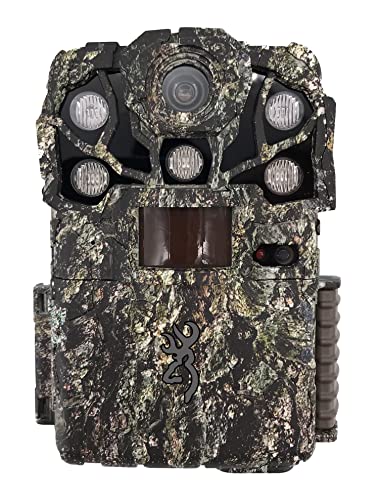
The Browning Recon Force Elite HP5 is the camera you buy when video is the priority and you still refuse to pay a subscription. It sits at the premium end of Browning's no-fee SD lineup, and its calling card is footage: 1080p at a full 60 frames per second with sound, paired with the RADIANT 5 infrared system that throws usable light a remarkable 130 feet into the dark. For anyone who wants to actually watch deer behave on video — not just collect stills — rather than feed a cellular plan, the HP5 is one of the most capable cameras in this catalog.
It's built on the same Browning foundations that earn the brand its loyalty: honest, well-processed image quality and excellent battery life, here on 8 AA cells, with SD support up to 512GB for long unattended runs and a generous 2-inch color screen for setup and review at the tree. The 24MP stills are clean and color-accurate in the Browning tradition — better than the inflated megapixel numbers on budget boxes — and the 100-foot detection range gives it a wide working zone. This is a serious tool that happens to be very good at video specifically.
The honest framing has two parts. First, like all Browning SD cams, it's a walk-to-it camera: no WiFi, no cellular, no app — you pull the card to see your footage. Second, and importantly for hunters, the HP5 uses a low-glow flash rather than a no-glow one. That low-glow design is part of how it achieves its long 130-foot night reach and crisp video, but it means a faint red glow is visible at night. Pressured deer and sharp-eyed people can see it. If total concealment is non-negotiable, the no-glow Strike Force Pro X is the better match; if video quality and long IR reach top your list, the HP5 earns its place.
This review walks the whole camera: the build and theft considerations of a premium body, what the trigger and detection do in the field, the low-glow flash tradeoff and why it matters, the card-pull workflow and the long-term cost math against cellular, the battery and cold-weather story, and who should choose the HP5 over its Strike Force sibling or a budget cam. If you want the best no-fee video in this lineup, start here.
Browning Recon Force Elite HP5 Trail Camera (24MP, RADIANT 5)
Prices may change · Free shipping with Prime
Design, Build & Theft Resistance
The Recon Force Elite HP5 is a bit larger than the compact Strike Force line, and that extra size buys you a couple of things: a bigger 2-inch color screen for framing and reviewing footage right at the tree, and room for the RADIANT 5 flash array and 8-AA battery bank. The case is the same tough, textured camo polymer Browning uses across its range, with a long-proven weatherproofing track record through rain, snow, and humidity swings. A gasketed door seals the SD slot, battery tray, and ports.
The 2-inch screen is genuinely useful on a video-focused camera — you can confirm framing and review clips on the spot, which matters more for video than stills since composition and angle make or break footage. Browning's menu system is mature and intuitive, so dialing in video resolution, frame rate, clip length, and trigger settings is fast. Mounting uses the integrated strap channel plus a tree-mount/tripod thread for posts and adjustable brackets.
Theft resistance follows the SD-cam norm and matters more here because the HP5 is a premium camera worth stealing: there's a slot for a Python-style cable lock and compatibility with Browning's security boxes and lock brackets, but no GPS or covert recovery. And note a subtlety specific to this model — because it's low-glow rather than no-glow, the faint red flash glow at night can reveal the camera's location to anyone watching, which slightly raises tampering and theft exposure compared to a fully covert cam. On any public-access, leased, or exposed spot, treat a steel security box sized for the HP5 as part of the purchase. On private land you control and walk, the built-in lock provisions are usually sufficient.
Detection & Trigger Speed in the Field
The HP5 is built around video, and its detection and timing reflect that. The 0.4-second trigger is slower than the Strike Force Pro X's 0.22 seconds and well behind the budget speed cams claiming 0.1 or 0.05 seconds — so for catching a fast-walking deer at the exact instant it crosses a narrow lane, the HP5 isn't the quickest draw. In practice, though, video mode changes the math: once triggered, the camera records a clip, so you capture the animal's behavior over several seconds rather than betting everything on a single instant. For video-first use, the slightly slower trigger is far less of a liability than it would be on a stills-only cam. The 100-foot detection range gives it a wide zone to work with, and recovery between events is quick.
On stills, the HP5 is rated at 24MP, and Browning's honest image processing means those 24 megapixels look better than the interpolated 48MP and 64MP claims on budget cameras. Those budget numbers are software-upscaled from much smaller sensors — more pixels, not more detail — whereas Browning engineers for clean, color-accurate, low-noise images. So don't let the smaller number fool you; the HP5's stills are genuinely high quality.
But video is the reason to buy it. The HP5 records 1080p at 60fps with sound — the smoothest, most detailed video of any SD camera in this catalog. Sixty frames per second renders motion fluidly, so a buck working a scrape or a doe browsing looks natural rather than stuttery, and the audio adds context (footsteps, vocalizations, the rustle of a feeding animal). Combined with the long-reach flash, the HP5 produces nighttime video that's actually watchable at distance, not just a dim smear. If you've ever wanted your trail cam to show you how animals move and behave rather than freeze them in a single frame, this is the camera that does it best here without a subscription.
Night Flash: No-Glow, Low-Glow or White?
This is the most important thing to understand before buying the HP5: it uses a low-glow infrared flash, not a no-glow one. Low-glow LEDs (typically 850nm) emit a faint red glow that's visible when the flash fires. That's a deliberate engineering choice — 850nm light is brighter to the sensor than the invisible 940nm light no-glow cams use — and it's a big part of how the HP5's RADIANT 5 system reaches a full 130 feet and produces such crisp, well-lit night video. You're trading a little concealment for more light and longer reach.
The practical consequence: at night, anyone or anything looking directly at the camera can see a faint red glow when it triggers. For a lot of uses that's a non-issue — backyard wildlife, video on private land, security where you don't care if the camera is visible, or even where a visible deterrent helps. But for hunting pressured, educated deer that have learned to spot and avoid the red wink of a low-glow camera, it's a real drawback. Mature bucks on heavily hunted ground may notice it and shift their pattern. If covertness is critical to your hunt, this is the wrong Browning.
So the decision is clean. Choose the HP5's low-glow flash when night-video quality and long IR reach matter most and a faint glow is acceptable. Choose the fully covert no-glow Strike Force Pro X when staying hidden from sharp-eyed deer is the priority, accepting its shorter 120-foot flash and stills-focused design. And if you want color night images for identification, neither infrared camera does that — that's a white-flash camera like GardePro's E8P, which is highly visible. This is the textbook no-glow versus low-glow versus white-flash tradeoff, and the HP5 lands squarely in the low-glow, long-reach, video-first camp.
WiFi & SD-Card Workflow — No Monthly Fee
The HP5 is a pure SD-card camera — no WiFi, no Bluetooth, no cellular, no app. You retrieve the SD card and read it on a phone (with an adapter) or a computer to see your photos and video. There's no wireless pull even up close; this is Browning's deliberate old-school approach, and it's bulletproof: nothing to pair, no connection to drop, no over-the-air firmware to wrestle. You walk to the camera, swap or pull the card, and review.
That workflow matters more on a video camera than a stills one, simply because the files are larger. The HP5 supports SD cards up to 512GB, and you'll want a high-capacity, high-endurance card — 1080p/60fps clips eat space fast, so a big, fast card is the difference between a long unattended run and a camera that fills up and stops recording. Format the card in the camera, size it generously, and you can leave the HP5 capturing for a long time between visits.
The payoff for all this is zero recurring cost. A cellular camera runs roughly $60 to $200 a year in data fees, and cellular cams generally can't send full-resolution 60fps video over a plan anyway — you'd get compressed clips or stills. The HP5 records full-quality video locally and costs you nothing after purchase, forever. Over three or four years, the plan fees you'd pay on a cellular cam can exceed the HP5's entire price, so for a video-focused hunter on a property they walk, the no-fee camera is often cheaper in total ownership despite the premium sticker. The tradeoff, as always, is no remote access — if you can't easily reach the camera, this isn't the right tool, and a cellular cam earns its plan. For everyone who's on the property anyway, the card pull is a non-issue, especially with a spare formatted card for swap-and-go visits.
Power, Batteries & Cold Weather
The HP5 runs on 8 AA batteries, and while it needs more cells than the compact 6-AA Strike Force, it still delivers the strong battery life Browning is known for. Video is the variable that matters most here: recording 1080p/60fps clips draws considerably more power than snapping stills, so a camera set to capture lots of long videos will go through batteries faster than one shooting occasional photos. Tune your clip length and trigger settings to your real needs and the HP5 will run a long time; set it to record maximum-length 60fps video on a busy site and plan to swap sooner.
Battery chemistry is the key lever, especially in cold. Lithium AAs (Energizer Ultimate Lithium and similar) are the right choice for any serious deployment — they hold voltage flat across their life, weigh less, resist leaking, and keep working in deep cold, which also helps maintain the flash power that good night video depends on. Alkalines run the camera in mild weather but sag in winter, can cause false low-battery shutdowns, and risk leaking and corroding contacts over a long sit. Given the HP5's video power draw, lithium is the obvious call.
In genuine cold, lithium AAs plus Browning's efficiency keep the HP5 shooting through hard freezes when lesser cameras quit, though heavy video will always shorten runtime relative to a stills-only cam. For long unattended or set-and-forget runs, the HP5 can be paired with an external power source via its power jack to extend operation and offset the video drain entirely. But the standard recommendation is straightforward: load 8 lithium AAs, size your video settings sensibly, use a big high-endurance card, and the HP5 will reliably capture a season of footage between visits.
Who Should Buy (And Who Shouldn't)
Buy the Browning Recon Force Elite HP5 if video is what you care about most and you won't pay a subscription. It's the best no-fee video camera in this catalog — 1080p/60fps with sound and a 130-foot illuminated night reach that lets you actually watch how deer move and behave rather than freeze them in a single frame. It's the right pick for the hunter who studies animal behavior on video, for the homesteader or wildlife watcher who wants smooth, detailed footage of what visits the property, and for anyone who values Browning's honest image quality, big setup screen, and strong battery life. The premium price buys genuine video capability and zero recurring fees.
Don't buy the HP5 if covertness is critical — its low-glow flash shows a faint red glow at night that pressured deer can notice, so for hidden, undetectable scouting choose the no-glow Strike Force Pro X instead. Skip it too if you mostly shoot stills and want the fastest trigger, since the Strike Force's 0.22-second trigger and no-glow flash make it the better stills hunter, often at a lower price. And as with every Browning SD cam, don't buy it if you need remote access — there's no WiFi or cellular, so a camera you can't walk to is the wrong application.
The clean way to decide between the two Brownings: HP5 for the best video and the longest IR reach with a faint visible glow; Strike Force Pro X for covert stills with a fully invisible flash. If your budget can't reach premium at all, GardePro's A3S gives you excellent night stills for a fraction of the price, though it can't touch the HP5's video. Pick the HP5 specifically because you want to watch, not just count.
Alternatives Worth Considering
The most direct alternative is Browning's own Strike Force Pro X. It's the covert stills counterpart to the HP5's video focus: a faster 0.22-second trigger, a fully invisible no-glow flash (versus the HP5's faintly visible low-glow), and a more compact, easier-to-hide body, usually at a lower price. The Strike Force tops out at 1080p/30 video and a 120-foot flash. So choose the HP5 for best-in-class 1080p/60 video and the longest 130-foot IR reach; choose the Strike Force Pro X for covert, fast stills where concealment beats video quality.
For buyers whose top priority is reliability rather than video, the Reconyx HyperFire 2 HP2X is the buy-it-once premium option: a consistent 0.2-second trigger, true no-glow covert IR, and over a year of battery life on 12 AAs, made in the USA. It shoots only 3MP and no video, and it costs significantly more, but for security and research where uptime is everything it's unmatched. It's the opposite philosophy from the HP5 — maximum dependability over multimedia richness.
And if the HP5's premium price is out of reach, the GardePro A3S is the value alternative for stills. It's a simple SD-card cam at a fraction of the cost, and its Sony Starvis sensor produces genuinely excellent night photos for under $60. It can't match the HP5's smooth 60fps video, long flash reach, or build refinement, but for a budget-conscious buyer who mainly wants good stills it covers the basics well. Net: HP5 for the best no-fee video, Strike Force Pro X for covert stills, Reconyx HP2X for ultimate reliability, A3S to save serious money on night stills.
Our Verdict
Buy it if you care most about video — 1080p/60 with sound and 130 ft illumination is unmatched in an SD cam. If you need full covertness, the no-glow Strike Force Pro X is the better match.
Browning Recon Force Elite HP5 Trail Camera (24MP, RADIANT 5)
$190
Prices may change · Free shipping with Prime
| Full Specifications | |
|---|---|
| Connectivity | sd |
| Monthly fee | None |
| Night flash | low-glow |
| Photo resolution | 24MP |
| Trigger speed | 0.4s |
| Detection range | 100ft |
| Flash range | 130ft |
| Power | 8x AA |
| Weather rating | Weatherproof |
| Storage | SD up to 512GB |
| Video | 1080p |
Frequently Asked Questions
Is there really no monthly fee with the Recon Force Elite HP5?
Does the HP5's flash spook deer at night?
Why buy the HP5 over the Strike Force Pro X?
Is the 24MP enough compared to 48MP or 64MP budget cams?
Does the HP5 have WiFi or an app?
What SD card should I use for video?
How long do the batteries last, and what should I use?
Is the HP5 good for backyard wildlife or property monitoring?
Related Buying Guides
Compare With Similar Trail Cameras
Spypoint
Flex-S
cellular · Free tier (100 photos); from $10/mo · low-glow
$168.08
Reconyx
HyperFire 2 HS2XC
cellular · Carrier plan required · no-glow
$659.99
Head-to-Head Comparisons
Browning Recon Force Elite HP5 Trail Camera (24MP, RADIANT 5)
$190
Prices may change · Free shipping with Prime