
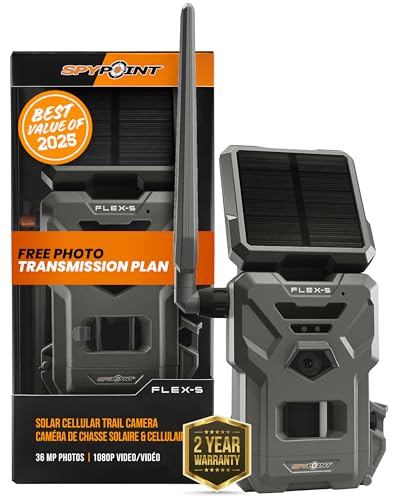
Spypoint
Flex-S
$168.08
Pros & Cons
Pros
- Integrated solar panel means you can hang it on a back-40 fence line and forget it for a season
- 36MP stills with 1080p sound video — a real step up over the Flex-M
- Same free 100-photo plan, so the solar premium doesn't add a forced subscription
- Dual-SIM auto-connect keeps it talking in spotty-coverage country
- Built-in rechargeable pack tops off from the sun all day
Cons
- Premium price — you're paying up front for the never-swap-batteries convenience
- Solar needs real sun exposure; deep-canopy north-facing trees will struggle
- Still low-glow, not fully covert at night
At a Glance
Overview
The Spypoint Flex-S is the camera that makes the strongest case for cellular scouting on a budget that respects recurring costs. It pairs an integrated solar panel with Spypoint's genuinely free 100-photo plan, which means you can hang it on a remote fence line or back-40 trail and walk away for a season without ever swapping a battery or paying a subscription. That combination of self-charging power and a no-cost plan is rarer than it should be in this category.
Street price runs around $200, putting the Flex-S in premium-cellular territory, but the value math is different from every other camera at that price. The integrated solar and built-in rechargeable pack mean you're not buying lithium AAs or a separate solar kit, and the free plan means the recurring cost can genuinely be zero. The spec sheet is competitive too: 36MP stills, 1080p video with sound, roughly 100 feet of detection, a 0.4-second trigger, dual-SIM auto-carrier connection, and an IP65 weather rating.
The core buying question is whether you want a true set-and-forget cellular camera and are willing to pay up front for the never-swap-batteries convenience. The Flex-S is the lowest-hassle long-haul cell cam in this catalog. The catches are real but narrow: it uses a low-glow flash rather than fully covert no-glow, and the solar panel needs honest sun exposure to keep the battery topped, so a deep-canopy north-facing tree will struggle.
This review covers how the Flex-S performs in the field, what the free plan really gets you before you'd consider paying, and how it compares with the Tactacam and Moultrie cellular options in our brand showdown.
Spypoint Flex-S Solar Cellular Trail Camera (Integrated Solar)
Prices may change · Free shipping with Prime
Design, Build & Theft Resistance
The Flex-S is a chunkier camera than the bare-bones cellular models because the solar panel is built into the top of the housing rather than dangling on a cable. That integrated design is cleaner to hang and means one fewer thing to position, though it does mean the whole camera has to sit where the sun is, which we'll come back to. The IP65 rating is a genuine ingress spec, sealed against dust and low-pressure water jets, so it handles driving rain and wet seasons better than the vaguely labeled weatherproof cameras.
The case closes on a positive latch with a gasketed door, and the build feels appropriately solid for a $200 camera meant to live outdoors for years. Spypoint's setup is app-driven and reasonably painless: you create an account, the dual-SIM finds a carrier, and you're scouting.
On theft resistance, the Flex-S includes GPS location tagging, which Spypoint markets for stand placement but which also helps if a camera goes missing, since you can see its last reported location. The housing accepts a cable lock through its mounting points, and Spypoint sells a steel security box that fits the Flex line for higher-risk public-land or shared-property sets. It's not as theft-hardened as the GPS-tracking-plus-lockbox Tactacam setup in the field, but between location tagging, a cable lock, and an optional steel box, you can reasonably secure it. For property security use, those same protections plus the always-on solar power make it a low-maintenance watcher for a gate or driveway.
Detection & Trigger Speed in the Field
The Flex-S is rated at a 0.4-second trigger, which is solidly mid-pack: quick enough for deer working a feeder, a scrape, or a field edge, but a step behind the 0.2 to 0.3-second flagships when an animal crosses a trail quickly. For the set-and-forget remote scouting this camera is built for, that's rarely a problem, because you're usually watching habitual travel and feeding rather than fast pinch-point crossings. Recovery between triggers is reasonable, though a fast group can leave a small gap.
Detection range is rated around 100 feet, with reliable, well-centered triggering closer to 70 to 90 feet in practice. As always, that headline number assumes a large warm animal moving broadside in good temperatures; angle and cold pull it down. Aim it across the trail to get the most consistent triggers.
The 36MP still resolution is a real step up over the Flex-M's 28MP and the entry Spypoint cameras, and the images look genuinely sharp for a mid-priced cell cam, with accurate daytime color. This is a true higher-resolution sensor than the budget Spypoints rather than an aggressively interpolated number, so the detail holds up for patterning bucks and identifying individual animals. The 1080p video with sound is a meaningful upgrade over the Flex-M's 720p, useful for confirming behavior, though as always, video pulls draw on your plan.
Night Flash: No-Glow vs Low-Glow
The Flex-S uses a low-glow infrared flash, in the 850nm range, and this is the one spec where it concedes ground to the covert cellular cameras. Low-glow LEDs emit a faint red glow when the flash fires, visible if a deer or a person is looking directly at the camera at night. The upside of 850nm is brighter, longer-reaching night images: low-glow simply puts more usable light on the subject than the invisible 940nm no-glow flash used by cameras like the Tactacam Reveal line.
So the trade-off is the inverse of the covert cameras. With the Flex-S you get better, brighter night photos at the cost of a small visible glow. For feeders, food plots, and remote scouting where the animals are relatively unpressured, that's often the better deal, because image quality matters more than total invisibility and habituated deer rarely react to the faint glow.
In the field, expect bright, well-exposed night images out toward the edge of the detection zone, noticeably more illuminated than a no-glow camera at the same distance. Where the low-glow flash becomes a liability is on heavily pressured public-land bucks or in security situations where you don't want to tip off an intruder. If covertness is your priority, look at a no-glow camera; our no-glow vs low-glow guide walks through exactly when each flash type wins.
Cellular Data Plans & Real Monthly Cost
This is the Flex-S's killer feature. Spypoint is the only major brand offering a genuinely free plan: 100 photos per month, per camera, forever, at no cost. For a low-traffic scouting set, that's often enough to run the camera indefinitely without ever paying a dime in subscription. No other brand in this catalog matches it, and it fundamentally changes the total-cost calculation against a $200 sticker.
The dual-SIM auto-carrier system picks the best available network so you're not locked to one tower, which keeps the camera talking in spotty country. When you outgrow the free tier, paid plans run roughly $10 to $20 a month for higher photo counts, HD images, and video. The realistic break point is traffic: a quiet trail stays free, but a busy feeder will blow through 100 photos in days and push you toward a paid plan.
That's the honest catch with the free tier, it fills up fast on a busy set, and once you start pulling HD versions and video clips, you're into paid territory just like any other brand. But the ability to start at zero recurring cost and only pay if and when you need more is a genuine advantage, especially for someone testing cellular scouting for the first time or running several low-traffic cameras. Our cellular data plans guide breaks down where the free tier holds up and where you'll want to upgrade.
Power, Batteries & Cold Weather
Power is the other half of the Flex-S's set-and-forget promise. The integrated solar panel feeds a built-in rechargeable pack, topping it off throughout the day, so in a sunny location the camera can run an entire season, or longer, without a battery trip. This is the single biggest maintenance advantage over the AA-hungry cellular cameras like the Tactacam Reveal line, which can demand lithium cells and regular service.
The critical caveat is sun exposure. Solar only works if the panel actually sees the sky. A deep-canopy site under heavy summer leaves, or a north-facing tree that stays shaded, will struggle to keep the pack charged, and in the short, overcast days of late fall and winter the camera can slowly draw down faster than it recharges. Place it where it gets real daylight, ideally with a southern exposure and a gap in the canopy, and the solar keeps up easily.
Cold weather is where you watch the battery most. Even a rechargeable pack loses capacity in deep cold, and combined with short winter daylight, a poorly placed solar camera can sag during a hard freeze. The fix is placement, not batteries: give it sky and southern light and it rides out winter fine. For shaded or canopy-heavy sites, a camera with a detachable solar panel you can position separately, or a straightforward AA camera with lithium cells, may be the more reliable choice.
Who Should Buy (And Who Shouldn't)
Buy the Flex-S if you want the lowest-hassle, lowest-recurring-cost cellular camera for remote sites you hate driving to. The integrated solar plus the free 100-photo plan is the truest set-and-forget combination in this catalog: hang it where it gets sun, and you may never touch it or pay a subscription. It's ideal for back-40 fence lines, remote food plots, and low-traffic scouting trails, and it's a strong, self-powering property-security watcher for a gate or driveway.
It's also the smart entry point for anyone testing cellular scouting for the first time, because the free plan lets you try it with zero recurring commitment. The 36MP stills and 1080p sound video are a real step up over the cheaper Spypoints, so you're not sacrificing much image quality for the value.
Skip it if covertness is non-negotiable: the low-glow flash emits a faint visible glow, so for heavily pressured public-land bucks or sensitive security work, a no-glow camera like the Tactacam Reveal or Stealth Cam Deceptor is the better tool. Skip it if your site is deep canopy or north-facing where solar can't keep up; a detachable-panel camera or an AA camera with lithium cells will be more reliable there. And skip it if you need the fastest trigger for a tight pinch point. For sunny, set-and-forget remote scouting on a budget that hates subscriptions, though, it's hard to beat.
Alternatives Worth Considering
The Spypoint Flex-M is the value sibling, around $110, that keeps the same free 100-photo plan and dual-SIM auto-connect but drops to 28MP stills, 720p video, and AA power without integrated solar. If you don't need solar, or your site is shaded enough that solar wouldn't help anyway, the Flex-M saves real money, though you'll want the LIT-22 rechargeable pack to tame its battery appetite. For a sunny set-and-forget location, the Flex-S's integrated solar is worth the premium.
The Moultrie Edge 2 Pro, around $160, is the feature-rich rival for hunters who want maximum capability over minimum cost. It connects across all four major carriers, triggers faster at 0.3 seconds, shoots 40MP and 1440p, runs a no-glow covert flash, and adds AI false-trigger filtering and onX Hunt integration. The catch is a $9.99 monthly entry plan with no free tier, so its total cost over time runs well above the Flex-S. Our Spypoint vs Tactacam vs Moultrie showdown weighs that free-plan-versus-features decision directly.
The Tactacam Reveal X-PRO, around $150 to $170, is the covert alternative if invisibility matters more than the free plan. It runs a true no-glow flash and GPS anti-theft and connects on dual carriers, but it's AA-powered and requires at least a $5-a-month annual plan. For pressured deer where the Flex-S's low-glow flash is a liability, the X-PRO is the more covert choice, at the cost of solar convenience and the free tier.
Our Verdict
The set-and-forget cell cam for remote sites you hate driving to. The integrated solar plus free plan is the lowest-hassle long-haul combo here — just give it sky.
Spypoint Flex-S Solar Cellular Trail Camera (Integrated Solar)
$168.08
Prices may change · Free shipping with Prime
| Full Specifications | |
|---|---|
| Connectivity | cellular |
| Monthly fee | Free tier (100 photos); from $10/mo |
| Night flash | low-glow |
| Photo resolution | 36MP |
| Trigger speed | 0.4s |
| Detection range | 100ft |
| Flash range | 90ft |
| Power | Solar + rechargeable |
| Weather rating | IP65 |
| Storage | microSD |
| Video | 1080p |
Frequently Asked Questions
Is the free Spypoint plan really free, and what does it include?
Does it work on Verizon or AT&T?
Do I ever have to change the batteries?
Will deer see the flash at night?
How good is the image quality compared with cheaper Spypoints?
What happens when I use up the 100 free photos?
Will solar keep up in winter?
Related Buying Guides
Compare With Similar Trail Cameras
Reconyx
HyperFire 2 HS2XC
cellular · Carrier plan required · no-glow
$659.99
Head-to-Head Comparisons
Spypoint Flex-S Solar Cellular Trail Camera (Integrated Solar)
$168.08
Prices may change · Free shipping with Prime