
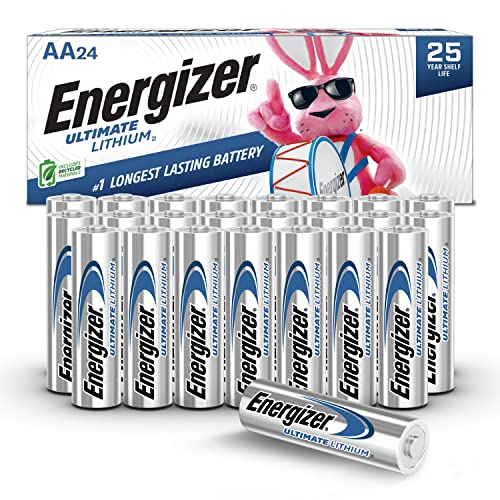
Energizer
Ultimate Lithium AA (L91)
$43.02
Pros & Cons
Pros
- The single biggest runtime upgrade for any AA trail cam — 2 to 3x alkaline life
- Rated -40°F to 140°F, so they don't die in a cold-snap when deer move most
- 15-year shelf life means you can stock up and store them
- Lighter than alkaline, which matters when you carry a dozen cameras' worth
- Steady voltage avoids the false low-battery warnings alkalines trigger in cold
Cons
- Pricey compared to alkaline up front
- Overkill for a low-traffic camera you check often
- A 24-pack only refills three 8-AA cameras
At a Glance
Overview
The Energizer Ultimate Lithium AA 24-pack is the single highest-value upgrade you can make to any AA-powered trail camera, and it fixes the two complaints that drive people crazy: cameras that die in the cold and cameras that eat batteries every few weeks. These are the L91 lithium cells — not rechargeables, not alkalines, but primary lithium AAs rated to operate from 40 below zero up to 140 degrees Fahrenheit, with two to three times the runtime of alkaline and a shelf life measured in decades. For a tool that lives outside through every season, that's not a luxury, it's the right chemistry for the job.
Most trail cameras in this market run on AA batteries — the budget GardePro, Vikeri, and Wosports cameras on 8 cells, compact models on 4, premium Brownings on 6, and the legendary Reconyx on 12. Every one of them benefits from lithium, and the benefit is largest exactly where it matters most: in winter, when deer move most and alkaline batteries fail first. If you've ever hiked out to a remote camera and found it dead with half a 'full' set of alkalines, you've met the problem this product solves.
The honest tradeoff is cost. Lithium AAs are noticeably more expensive than alkaline up front, and a 24-pack only refills three 8-cell cameras. For a camera you check every few days and can swap batteries in conveniently, premium lithium can be overkill. But the moment a camera is somewhere you can't easily reach — or somewhere it sits through a hard winter — the math flips hard in lithium's favor, as I'll break down in the cost section.
This review covers why lithium is non-negotiable for serious trail-cam use, how it performs in cold weather and over years of storage, the real cost-per-month picture versus alkaline and solar, and who should buy a 24-pack versus a smaller pack or a different power strategy entirely.
Energizer Ultimate Lithium AA Batteries, 24-Pack
Prices may change · Free shipping with Prime
Why Lithium AAs Are Non-Negotiable for Trail Cams
The case for lithium starts with how trail cameras actually fail. The most common non-mechanical failure is a battery that died early, and the usual cause is alkaline chemistry doing what alkaline does: sagging in voltage under load and in cold, dropping below the camera's cutoff long before the cells are truly empty. A trail camera draws hard, bursty current when it fires the IR flash and writes a photo or clip, and alkalines handle those high-current bursts poorly — voltage dips, the camera reads it as a dead battery, and it shuts down or throws a false low-battery warning with plenty of capacity left unused.
Lithium AAs solve this at the chemistry level. They hold a steady, flat voltage almost all the way through their life, deliver high-current bursts without the voltage sag, and simply store more usable energy — which is why they run two to three times longer than alkaline in the same camera. That flat discharge curve also means the camera's battery meter stays accurate and you avoid the false-dead shutdowns entirely. For a device whose whole job is to be ready at any moment, that reliability is the point.
There's a second, quieter benefit: leak resistance. Alkaline batteries are notorious for leaking corrosive electrolyte as they age or sit drained, and a leak inside a trail camera can ruin the contacts or the whole unit. Lithium primary cells are far more leak-resistant, which protects the camera itself — meaningful when the camera costs many times what the batteries do. Between longer life, cold-weather steadiness, no false shutdowns, and leak resistance, lithium isn't a marginal upgrade; for any camera you rely on, it's the correct default.
Cold-Weather Performance & Shelf Life
Cold weather is where lithium earns its reputation and where alkaline embarrasses itself. These Energizer Ultimate Lithium cells are rated to operate down to 40 degrees below zero Fahrenheit, and they hold usable voltage across that entire range. Alkaline batteries, by contrast, lose capacity rapidly as temperatures fall — by deep winter an alkaline-powered camera can shut down on a cold morning, exactly when whitetails are most active and you most want the camera working. For anyone scouting or running security through winter, the cold-weather edge is the headline reason to switch.
The practical effect is twofold: the camera keeps firing through freezing nights instead of going dark, and the runtime stays long rather than collapsing in the cold the way alkaline does. A set of alkalines that might last a couple of months in mild weather can fade dramatically once it's genuinely cold; lithium holds its multi-month runtime regardless. If your camera sits somewhere you can't easily reach in winter, that difference can be the entire season's footage versus a dead box.
Shelf life is the other standout: these cells are rated to hold their charge for up to around 20 years in storage. That changes how you buy and stock batteries — you can purchase a 24-pack, use what you need, and store the rest for years with no meaningful self-discharge, confident they'll be full when you grab them. For someone running multiple cameras and rotating fresh cells in seasonally, that long shelf life means a bulk purchase never goes to waste, and you always have known-good batteries on hand.
Real Cost-Per-Month vs Alkaline & Solar
The sticker shock is real — a 24-pack of lithium costs several times what a comparable count of alkalines does — but cost-per-month tells the truer story. Because lithium runs two to three times longer per set, the per-month cost gap narrows far more than the shelf price suggests. And once you factor in cold weather, where alkaline runtime collapses, lithium can actually win outright in winter deployments. The more often you'd otherwise be swapping alkalines, the better lithium looks; the value compounds on cameras you can't check frequently.
There's a hidden cost lithium eliminates that rarely shows up in the price comparison: the trips. Every battery swap on a remote camera is a drive, a hike, and a disturbance to the area you're trying to monitor — and on a hunting setup, human intrusion to change dead alkalines can spook the very deer you're patterning. Fewer swaps means fewer trips and less disturbance, which has real value beyond the battery cost itself. For a remote or sensitive camera, lithium buys you time and stealth, not just runtime.
Versus solar, the calculus is different. A solar-equipped or solar-add-on camera can run nearly indefinitely in good sun and is the lowest long-run cost for a permanent, sun-exposed installation. But solar needs genuine sun exposure — a deep-canopy or north-facing site may never keep up — and not every camera has a solar port. Lithium is the universal answer: it works in any AA camera, in any location, in any light, with no extra hardware. Many serious users run both, using solar where the sun allows and lithium AAs everywhere else, including as the backup that keeps a solar camera alive through a long cloudy stretch.
Who Should Buy (And Who Shouldn't)
Buy the 24-pack of Energizer Ultimate Lithium if you run AA-powered cameras you can't check often, or any camera that sits through cold weather. That covers most hunters and property-security users: remote stand cameras, gate and barn cameras, anything on land you visit occasionally, and every camera that has to keep working through winter. If you own several AA cameras, the 24-pack is the efficient way to buy, and the long shelf life means leftover cells store for years without waste. For a Reconyx or other long-runtime camera, lithium is effectively assumed — it's how you reach the headline year-plus battery life.
Think twice only if your camera is somewhere genuinely convenient — a backyard wildlife cam steps from the door that you check constantly, where swapping cheaper alkalines is trivial and the cold-weather and trip-saving benefits don't apply. In that narrow case, premium lithium can be more than you need. Likewise, if a camera already runs on an integrated rechargeable pack or solar and you have good sun, you may not need many AAs at all.
A realistic note on quantity: a 24-pack refills three 8-cell cameras, or four 6-cell Brownings, or two 12-cell Reconyx units. Map the pack to your fleet before buying so you get enough to do a full rotation. For most people running two or three cameras, a single 24-pack is one clean refill cycle with a few spares — and at that point you've fixed dead-in-the-cold and constant-swap failures across your whole setup in one purchase.
Alternatives Worth Considering
The first alternative is doing nothing different — sticking with alkaline AAs. They're cheap and fine for a backyard camera you check every few days in mild weather. But for any camera that's remote, hard to reach, or running through winter, alkaline is a false economy: the early deaths, false low-battery shutdowns, cold-weather collapse, and leak risk are exactly the failures lithium exists to prevent. Reserve alkaline for the easy, convenient, warm-weather cameras only.
Rechargeable AAs (typically NiMH) are the next option, attractive for cutting long-term cost and waste on a high-traffic camera you service regularly. The catch is voltage: rechargeables run at a lower nominal voltage than lithium or alkaline and sag under the camera's high-current flash bursts, so many cameras read them as low or get shorter runtime from them. They also self-discharge in storage and lose capacity in the cold. For a convenient, frequently-checked camera they can work; for cold-weather or remote use, they're the weakest of the three.
For true set-and-forget power, solar is the alternative worth pairing rather than replacing. A camera with integrated solar, or an AA camera fed by a compatible external solar panel, can run a whole season in good sun with minimal battery intervention. The limits are real — it needs genuine sun, and not every camera has the right power port — so the strongest setup for serious users is often both: solar where the location allows, with lithium AAs as the universal backup that keeps any camera alive in shade, in winter, or through a long stretch of clouds.
Our Verdict
If your cameras run on AAs, these are the upgrade that fixes the most complaints — dead cams in the cold and constant battery swaps. Buy them for any camera you can't check often.
Energizer Ultimate Lithium AA Batteries, 24-Pack
$43.02
Prices may change · Free shipping with Prime
| Full Specifications | |
|---|---|
| Connectivity | — |
| Monthly fee | — |
| Night flash | — |
| Photo resolution | — |
| Trigger speed | — |
| Detection range | — |
| Flash range | — |
| Power | 24x AA lithium (L91) |
| Weather rating | -40°F to 140°F |
| Storage | — |
| Video | — |
Frequently Asked Questions
How many cameras will a 24-pack run?
Are lithium AAs really worth it over alkaline?
How do they perform in cold weather?
Will lithium batteries leak in my camera?
How long do they last in storage?
Should I use lithium AAs or rechargeables?
Do I still need batteries if my camera has solar?
Compare With Similar Trail Cameras
Head-to-Head Comparisons
Energizer Ultimate Lithium AA Batteries, 24-Pack
$43.02
Prices may change · Free shipping with Prime