
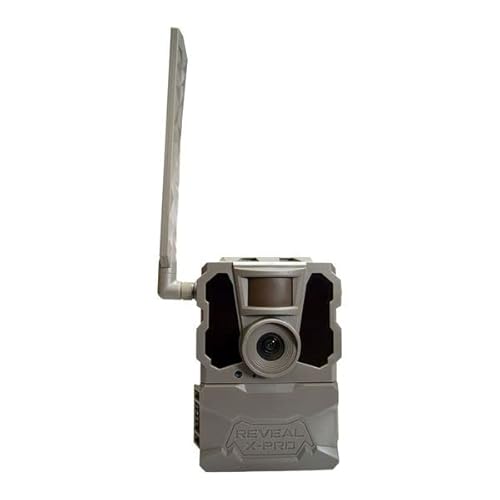
Tactacam
Reveal X-PRO
$99.99
Pros & Cons
Pros
- Auto dual-carrier connection grabs whichever of Verizon or AT&T is stronger at the tree, so you don't guess SIMs before you hang it
- Built-in GPS theft tracking means if someone walks off with it, you can still see where it went
- True no-glow IR flash stays invisible at night — deer and trespassers never see it light up
- On-camera LCD lets you frame the shot and confirm signal bars on-site instead of guessing
- Tactacam plans start around $5/mo on the annual tier with no contract
Cons
- 0.4s trigger is fine but a hair slower than the fastest SD cams when a buck crosses quick
- Eats 16 AA cells fast unless you add the LiPo pack or a solar panel
- Best features (on-demand pulls, HD) live behind the app and a paid plan
At a Glance
Overview
The Tactacam Reveal X-PRO is the camera that turned a lot of skeptical SD-card hunters into cellular believers, and it earns that reputation by getting two unglamorous things right: it connects on its own, and it tells you where it is if someone steals it. The dual-carrier radio scans both Verizon and AT&T at the tree and locks onto whichever tower is stronger, so you don't have to guess a SIM before you hang it. Built-in GPS theft tracking and a true no-glow flash round out a feature set aimed squarely at serious hunters running cameras on leased or public ground.
Street price hovers around $150 to $170 depending on the season, which puts the X-PRO in premium-cellular territory but well under the Reconyx and Spypoint Flex-S tier. The headline spec sheet reads 96MP stills, a 0.4-second trigger, roughly 96 feet of detection, and that covert 940nm-class no-glow flash. Power is the catch nobody warns you about: 16 AA cells, which is a real commitment unless you add the LiPo pack or a solar panel.
The core buying question with any Tactacam isn't really about the hardware. It's about the ecosystem. You're buying into the Reveal app and a data plan that starts around $5 a month on the annual tier. If you want a camera that you set, walk away from, and check from your phone all season, the X-PRO is one of the most proven ways to do it. If you balk at recurring fees on principle, you'll want to look at the no-monthly-fee WiFi and SD cameras instead.
This review breaks down what the X-PRO actually delivers in the field, what the data plans really cost once HD pulls and video enter the picture, and which hunters and property owners should buy it versus the alternatives in our cellular brand showdown.
Tactacam Reveal X-PRO Cellular Trail Camera (Dual-Carrier)
Prices may change · Free shipping with Prime
Design, Build & Theft Resistance
The X-PRO carries the familiar boxy Tactacam Reveal silhouette in a flat olive shell that disappears against bark better than the gloss-black cameras some brands still ship. It's compact for a 16-AA camera, and the case seals up against weather well enough to ride out a full season of rain, snow, and freeze-thaw cycles. The single front latch is plastic, which is the one spot we'd treat gently in deep cold, but it closes positively and the gasket does its job.
The on-camera LCD is the build feature that pays for itself. Instead of hanging the camera blind and hoping, you can frame the shot, confirm your signal bars on-site, and see that it's connected before you walk out. That single screen eliminates the classic cellular-cam frustration of driving home only to find the camera never had service where you put it.
Theft resistance is where the X-PRO genuinely separates from cheaper cell cams. The integrated GPS anti-theft means that if a camera walks off, you can still see where it went from the app, which has recovered more than a few cameras off public land. For physical security, the case accepts a Python-style cable lock through the mounting points, and Tactacam sells a model-specific CAMLOCKbox steel enclosure if you're hanging it somewhere genuinely sketchy. Between GPS tracking, a cable lock, and a lockbox, this is about as theft-hardened as a consumer cellular camera gets. If you run cameras on shared leases or public ground, that combination is the real reason to choose this over a budget cell cam.
Detection & Trigger Speed in the Field
Tactacam rates the X-PRO at a 0.4-second trigger. In practice that's quick enough for deer working a scrape, a feeder, or a field edge, but it is a half-step behind the 0.2 to 0.3-second flagships when a buck crosses a trail at a fast walk. If your sets are mostly stand-and-mill locations, you'll never notice. If you're covering a pinch point where animals move through quickly, expect the occasional half-in-frame photo. Recovery time between triggers is reasonable but not instant, so a group of does filing past can leave a gap or two.
The detection range lands around 96 feet on paper, and real-world useful detection is closer to 60 to 80 feet for reliable, centered triggers. As with every PIR camera, the marketing number assumes a large, warm animal moving broadside across the sensor in ideal temperatures; a deer quartering toward the lens trips it later. Aim it across the trail, not down it, and you'll get the most out of the sensor.
Then there's the 96MP figure, which deserves an honest asterisk. That is an interpolated number, not the native resolution of the image sensor. The camera captures at a lower true resolution and upscales in software. The actual photos look good, plenty sharp for patterning a buck and identifying individual animals, but don't expect a 96MP camera's worth of detail. Daytime stills are crisp with accurate color, and 1080p video is serviceable for confirming behavior, though video pulls are where your data plan starts to matter.
Night Flash: No-Glow vs Low-Glow
The X-PRO uses a true no-glow infrared flash, in the 940nm range, and this is one of its strongest selling points. No-glow means the LEDs emit invisible light: there is no red glow when the flash fires, so deer never see it light up and a trespasser walking past at night sees nothing. For pressured public-land bucks and for security work where you don't want to advertise a camera's presence, that invisibility is worth a lot.
The trade-off, and it's the same trade-off on every no-glow camera, is that 940nm light is dimmer and reaches a bit shorter than the 850nm low-glow LEDs used on cameras like the Spypoint Flex-S or Moultrie Edge 2. Low-glow puts out a faint but visible red glow and produces brighter, slightly longer-range night images in exchange. With the X-PRO you give up a little night reach and brightness to gain total covertness.
In the field, the X-PRO's night photos are clean and well-exposed inside roughly 50 to 80 feet, with the usual no-glow softening and that flat infrared look on subjects at the far edge of the flash. If a critical part of your decision is covertness, this is the right tool. If you mainly run feeders and food plots where the animals are habituated and you want the brightest possible night image, our no-glow vs low-glow guide walks through when the low-glow cameras actually make more sense.
Cellular Data Plans & Real Monthly Cost
This is the math that separates a smart cellular purchase from buyer's remorse. The X-PRO's dual-carrier radio auto-connects to whichever of Verizon or AT&T is stronger, which is genuinely useful because it means one camera works in country where a single-carrier cam would be dead. You don't buy or choose a SIM; the camera sorts it out.
Tactacam's Reveal plans are among the more affordable in the category. Paid monthly, plans run roughly $5 to $13 per camera depending on the photo tier, and committing to an annual plan drops the entry tier to about $5 a month billed yearly. There's also an unlimited tier for high-traffic sets, and none of it requires a contract. Compared with Moultrie Mobile's $9.99 entry point, Tactacam's annual pricing is one of the cheaper ways to run a fleet.
The gotcha that catches new cellular users is the difference between thumbnail photos and full-resolution or HD pulls, plus video. Many plans send you a compressed preview and charge you, in photo allotment or plan tier, to pull the full-quality image or a video clip on demand. A busy feeder can blow through a low photo cap fast, especially if you're requesting HD versions of everything. Budget realistically: a single camera on a moderate plan is around $60 to $150 a year on top of the hardware. Run that number before you buy, and read our cellular data plans guide for tier-by-tier breakdowns across the brands.
Power, Batteries & Cold Weather
The X-PRO's appetite for batteries is the single thing we'd warn every buyer about. It runs on 16 AA cells, and if you load it with cheap alkalines you'll be back at the tree in weeks, not months. Alkaline batteries sag badly under the current spikes a cellular radio demands, and they fail fast in the cold, which is exactly when you least want to be servicing a camera.
Lithium AAs are effectively mandatory here. Energizer Ultimate Lithium cells deliver two to three times the runtime, weigh less, and keep their voltage from roughly -40°F to 140°F, so they hold up through a hard-freeze winter when alkalines quit. They cost more up front, but across a 16-cell camera the extra runtime and cold-weather reliability pay for themselves in fewer trips.
The better long-term answer is solar. Tactacam sells a LiPo battery pack and solar panel for the Reveal line, and once you add solar the X-PRO becomes a genuine set-and-forget camera that can run an entire season without a battery trip. For remote sets you hate driving to, the solar route is the one we recommend. Plan on lithium AAs at minimum and solar if the location justifies it; budgeting for power from day one is the difference between a camera that runs all season and one that dies in November.
Who Should Buy (And Who Shouldn't)
Buy the X-PRO if you're a serious hunter running cameras on leases or public ground where you can't drive out to check cards every week, and especially if theft is a real concern. The combination of dual-carrier auto-connect, GPS anti-theft, a true no-glow flash, and Tactacam's low annual plan pricing makes it one of the best total-cost covert cellular cameras available. It's also a strong property-security tool for the same reasons; the invisible flash and GPS tracking matter as much on a gate or a back fence line as they do on a deer trail.
It's a great fit for someone who wants to run several cameras across a property and check them all from the couch, and who's willing to invest in lithium AAs or solar to keep them alive. If you already own Tactacam cameras, the app and plan ecosystem make adding an X-PRO frictionless.
Skip it if you object to monthly fees on principle: a no-monthly-fee WiFi camera like the GardePro E8 family or an SD card cam gets you images for free as long as you don't mind walking to the camera. Skip it if you need the fastest possible trigger for a tight pinch point, where a 0.2 to 0.3-second camera serves better. And skip it if you want the brightest, longest-reaching night images, where a low-glow camera wins. For everyone running covert cellular on ground they don't want to babysit, though, the X-PRO is a top pick.
Alternatives Worth Considering
The Tactacam Reveal Pro 3.0 is the obvious step-up within the same family. It uses the same core sensor and no-glow flash but adds faster multi-network connecting, Wi-Fi setup so you can configure it from your phone at the tree, and tighter solar integration. If you want the newest Tactacam and don't mind paying roughly $180, it's the upgrade pick; the X-PRO is the value play if you're happy with the proven hardware.
The Moultrie Edge 2 Pro is the cross-brand rival to beat at around $160. It connects across all four major carriers rather than two, triggers faster at 0.3 seconds, shoots 40MP and 1440p, and adds AI false-trigger filtering plus onX Hunt map integration. The catch is its cloud-only, no-SD design and a $9.99 monthly entry plan. If nationwide connection reliability and onX integration matter more than Tactacam's cheaper annual plan, the Edge 2 Pro is the stronger feature set. Our Spypoint vs Tactacam vs Moultrie showdown digs into that decision.
Finally, the Spypoint Flex-S at around $200 is worth a look if recurring cost is your main worry: it ships with integrated solar and Spypoint's genuinely free 100-photo plan, so you can run it for years without a battery swap or a subscription. It uses a low-glow flash rather than no-glow, so it's a touch less covert, but for set-and-forget remote sites where total cost matters more than invisibility, it's a compelling alternative.
Our Verdict
The covert cell-cam workhorse for serious hunters — dual-carrier connection and GPS anti-theft are the standouts, and the $5/mo entry plan keeps total cost honest. Budget for lithium AAs or solar from day one.
Tactacam Reveal X-PRO Cellular Trail Camera (Dual-Carrier)
$99.99
Prices may change · Free shipping with Prime
| Full Specifications | |
|---|---|
| Connectivity | cellular |
| Monthly fee | From $5/mo |
| Night flash | no-glow |
| Photo resolution | 96MP |
| Trigger speed | 0.4s |
| Detection range | 96ft |
| Flash range | 80ft |
| Power | 16x AA (or LiPo pack) |
| Weather rating | Weatherproof |
| Storage | microSD up to 32GB |
| Video | 1080p |
Frequently Asked Questions
Does the Reveal X-PRO work on Verizon or only AT&T?
What does the cheapest data plan actually cost per year?
Will deer or trespassers see the flash at night?
How many batteries does it take and how long do they last?
Can I lock it to a tree to prevent theft?
Is the 96MP resolution real?
Do I have to use the app, or can I pull an SD card?
Related Buying Guides
Compare With Similar Trail Cameras
Spypoint
Flex-S
cellular · Free tier (100 photos); from $10/mo · low-glow
$168.08
Head-to-Head Comparisons
Tactacam Reveal X-PRO Cellular Trail Camera (Dual-Carrier)
$99.99
Prices may change · Free shipping with Prime