
GardePro
A3
$69.99
Pros & Cons
Pros
- Excellent low-light images for $50 — a longtime value favorite
- 0.1s trigger keeps up with fast backyard wildlife
- Simple, dependable, just-works SD-card design
- No-glow flash stays discreet
- IP66 build shrugs off rain and snow
Cons
- No connectivity — card pulls only
- 48MP sensor steps down from the A3S's 64MP
- AA-only power
At a Glance
Overview
The GardePro A3 is the cheapest trail camera I'd actually trust, and that's a higher compliment than it sounds. The sub-$60 shelf is littered with disposable junk — cams that miss triggers, blow out their night photos, or die after one wet season. The A3 is the longtime value favorite that quietly does the boring things right: a fast 0.1-second trigger, a 100-foot detection range, clean low-light images, a covert no-glow flash, and a weatherproof IP66 body, all for around $50 with no subscription and nothing to pair.
It's the simplest kind of trail camera there is. No WiFi, no app, no cellular — you strap it to a tree, set it on its little screen, and pull the SD card when you want to see what walked by. That stripped-down design is exactly why it's reliable: there's very little to break and nothing to go wrong with a connection because there is no connection. GardePro put the budget into the fundamentals, and for casual scouting and backyard wildlife the A3 delivers them without drama.
The honest positioning is that the A3 is the step-down from GardePro's A3S. The A3S costs about $10 more and adds a genuinely better Sony Starvis night sensor; the A3 uses a more ordinary sensor and a 48MP interpolated mode instead of the A3S's 64MP. In daylight you'd struggle to tell them apart. At night the A3S pulls ahead. So the A3's whole reason to exist is price: it's the camera you buy when every dollar counts, or when you want to scatter several cheap-but-reliable cams across a property.
This review lays out what the A3 actually does well, where it gives ground to its pricier sibling, how the no-glow flash and night images hold up, what the pure card-pull workflow is like to live with, and who should buy the A3 versus stepping up to the A3S or a connected cam. If you want the lowest-cost trail camera that won't embarrass you, this is it.
GardePro A3 Trail Camera (Non-Cellular)
Prices may change · Free shipping with Prime
Design, Build & Theft Resistance
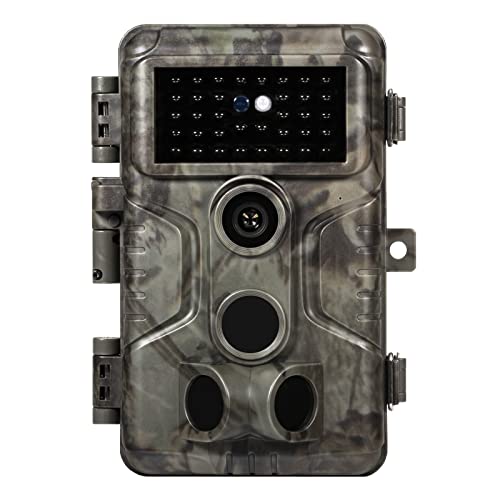
The A3 shares the compact, boxy camo body that runs through GardePro's budget line — light, easy to conceal on a small tree, and more solidly built than its price implies. The IP66 weather rating has held up to rain and snow in my use, with a gasketed door sealing the SD slot, battery tray, and the small setup screen. A single ratchet strap holds it rock-steady, and a tripod thread underneath opens up fence posts and homemade mounts. There are no flimsy latches or sloppy seams here; for $50 the hardware feels honest.
Because there's no app, all setup happens on the camera itself through a simple screen and button pad. The menus are basic and quick to learn — photo or video, resolution, trigger interval, time-lapse — so even a complete beginner is up and running in a couple of minutes without cracking the manual.
Theft resistance is minimal, which is true of essentially everything at this price: there's a slot for a python cable lock and security-box compatibility, but no GPS and no locking latch. The no-glow flash at least keeps the camera from announcing itself at night, a small deterrent against opportunistic theft. For backyards, private land, and near-cabin spots — where most A3 owners run it — that's adequate. On public or leased ground, budget for a steel lockbox and cable; at this price the box may cost as much as the camera, but it's the sensible move where strangers wander. Match the security to the location, not to the sticker price.
Detection & Trigger Speed in the Field
The A3 gets the field fundamentals right, which is the whole point of buying one. The 0.1-second trigger is genuinely fast — quick enough to catch a deer mid-stride centered in the frame instead of just its back end leaving — and that speed is the same as cameras costing far more. The detection range is a rated 100 feet, excellent for the money, giving you dependable usable triggers well past 80 feet in open woods and letting a single camera cover a decent lane or field edge. Recovery between shots is fast enough to grab a sequence of the same animal rather than one isolated frame.
On resolution, the A3 advertises 48MP stills, and as with virtually every budget cam that number is interpolated — the native sensor resolution is lower and the camera scales the image up in software, adding pixels but not true detail. So treat 48MP as a marketing figure, not a measure of crop-able sharpness. The real-world images are clean and plenty to identify a buck's rack, a coat color, or a person, but they're not DSLR crops. This is the honest expectation for the category regardless of the brand or the number printed on the box.
Where the A3 specifically gives ground is the sensor versus its A3S sibling. In daylight the two are very close. At night, the A3's more ordinary sensor produces good-but-not-class-leading low-light images, while the A3S's Sony Starvis sensor pulls clearly ahead. Video records at up to 1296p with audio and is fine in daylight, acceptable at night within flash range. For casual scouting and backyard wildlife, the A3's capture chain is more than good enough; it just isn't the night-image standout the slightly pricier A3S is.
Night Flash: No-Glow, Low-Glow or White?
The A3 uses a true no-glow infrared flash — 940nm LEDs that emit no visible red glow when they fire — putting it on the covert end of the spectrum. You won't see it light up in the dark, which keeps it hidden from pressured deer that have learned to spot the faint red wink of cheaper 850nm low-glow cams, and discreet for property monitoring where you don't want to advertise the camera at night. For its typical budget-conscious buyer, no-glow is the right and welcome choice.
The standard physics tradeoff applies: 940nm light is dimmer to the sensor than 850nm, so no-glow cams generally give up some night brightness and reach in exchange for invisibility. The A3 manages this acceptably for its price — night stills out to the effective flash range are usable and evenly lit enough to identify animals — but this is also the clearest place the A3 trails the A3S. Without the Starvis low-light sensor, the A3's night images don't claw back as much of that lost brightness, so they're a notch softer and noisier in the dark than its sibling's. Beyond the flash range the frame goes dark, as on every IR camera, so place it for the distance you actually need.
If you want color night images — to recognize a face, read a plate, or tell two similar deer apart by coat — the A3 can't do it; that's a white-flash job, and GardePro's E8P is the family member built for that (at the cost of a visible flash). For covert, no-one-sees-it black-and-white night coverage on the cheapest reliable platform, the A3's no-glow flash does the job. This is the standard no-glow versus low-glow versus white-flash decision, and the A3 sits in the covert no-glow camp — just a step behind the A3S on outright night quality.
WiFi & SD-Card Workflow — No Monthly Fee
The A3 is a pure SD-card camera with no connectivity whatsoever — no cellular, no WiFi, no Bluetooth, no app. There is one way to see your photos: retrieve the microSD card and read it on a phone (with an adapter) or a computer. You walk to the camera, pull or swap the card, and review. It's the oldest and most dependable workflow in the category, and for a casual user it's genuinely all you need.
The upside of this stripped-down approach is reliability and cost. There's no app to fail, no firmware to wrestle over WiFi, no pairing to drop — and no subscription, ever. The money GardePro didn't spend on radios went into the basics that make the A3 trustworthy. Against cellular cameras the savings are stark and permanent: a cellular cam costs roughly $60 to $200 a year in data fees, while the A3 costs nothing after purchase, on top of being one of the cheapest cameras to buy in the first place. Over a few seasons that's hundreds of dollars you simply never spend.
The tradeoff is zero remote convenience: you can't see a single photo without going to the camera and handling the card. If reaching the camera is impractical — a far-off stand or a distant lease — you want a connected cam and should accept the plan. But if you're at the property anyway, the card pull is fast and foolproof. Carry a spare formatted card and you can swap-and-go in seconds, reviewing at home while the camera keeps running undisturbed. For a no-monthly-fee buyer who prizes simplicity and price over connectivity, the A3 is about as straightforward as it gets.
Power, Batteries & Cold Weather
The A3 runs on 8 AA batteries with no rechargeable option, so battery chemistry is your main runtime lever. Alkalines work but are the weak link: they sag in cold weather, their falling voltage can trigger false low-battery shutdowns while charge remains, and they're prone to leaking and corroding contacts over a long sit. Lithium AAs (Energizer Ultimate Lithium and similar) hold voltage flat across their life, weigh less, resist leaks, and survive deep cold — for any camera you leave out through a season, they're the right call. Rechargeable NiMH AAs are usable but their lower voltage can slightly weaken flash output.
Because the A3 has no power-hungry WiFi or cellular radios, it sips battery. Real-world life depends on photo and video volume and night flash use, but on a moderate trail with lithium AAs, multi-month runtime is very achievable — often better than connected cameras that drain power keeping radios alive. Heavy video and a busy night-active feeder site will shorten that, as with any cam.
In the cold, the guidance is simple: load lithium AAs from the start. They're the difference between a camera that keeps shooting through a hard freeze and one that quits on "dead" alkalines that were merely voltage-sagging. The A3 doesn't have a built-in solar or rechargeable system, so plan battery swaps around when you visit the camera, and lean lithium for any winter deployment. For its price, the A3's low power draw makes it an easy and cheap camera to keep alive across a long season.
Who Should Buy (And Who Shouldn't)
Buy the GardePro A3 when price is the priority and you want a reliable camera that nails the basics. It's the right pick for a tight budget, for a first camera where you don't want to overspend before you know you'll use it, and especially for scattering several affordable-but-dependable cams across a property to cover multiple spots cheaply. The fast trigger, long detection, covert no-glow flash, and weatherproof build mean you get real trail-cam performance — not disposable junk — for around $50, with no fees and nothing to pair.
Don't buy the A3 if night image quality is your top concern — spend the extra $10 on the A3S and its Sony Starvis sensor instead; that small premium buys the single biggest real-world improvement available in this family. Also skip the A3 if you need any remote access (it's card-pull only, so a far-off camera is impractical), if you want color night ID for security (that's the white-flash E8P's job), or if pulling photos to your phone over WiFi appeals to you (the GardePro E8 adds that for a bit more money).
The clean way to think about it: the A3 is the value floor of cameras actually worth owning. If your budget is firm at the bottom or you're buying in quantity, it's the smart choice. If you can stretch a little and care about night photos, the A3S is the upgrade worth making. Either way you're getting a dependable GardePro, not a gamble.
Alternatives Worth Considering
The single most relevant alternative is the GardePro A3S. For about $10 more it keeps everything the A3 does well — the SD-card simplicity, the fast trigger, the no-glow flash, the long detection — and adds a Sony Starvis low-light sensor plus a 64MP interpolated mode. The night-image improvement is real and noticeable, which is exactly why the A3S is usually the better buy. Choose the plain A3 only if the lowest possible price or buying in bulk is the deciding factor; otherwise the A3S is worth the small stretch.
If you want the same no-fee philosophy but with photos pulled to your phone over WiFi rather than via the card, the GardePro E8 adds a local WiFi/Bluetooth app workflow (within roughly 45 feet) on top of a similar fast trigger and no-glow flash, for a bit more money. It's the pick if the card pull is the part you'd rather avoid.
And for the budget speed-and-width seeker, the Vikeri 4K 48MP brings a remarkable 0.05-second trigger, a 130-degree wide lens, and 4K video for under $50. Its detection range is shorter than the A3's 100 feet and its off-brand build and firmware are a bigger gamble than GardePro's proven reliability, but as a cheap, ultra-fast extra camera it's worth considering. Net: A3 for the lowest reliable price, A3S for clearly better night quality, E8 for WiFi pulls, Vikeri for raw trigger speed and a wide field of view.
Our Verdict
The cheapest reliable trail cam worth owning. Step down from the A3S to save $10 if you don't need the top night sensor — it still nails the basics every time.
GardePro A3 Trail Camera (Non-Cellular)
$69.99
Prices may change · Free shipping with Prime
| Full Specifications | |
|---|---|
| Connectivity | sd |
| Monthly fee | None |
| Night flash | no-glow |
| Photo resolution | 48MP |
| Trigger speed | 0.1s |
| Detection range | 100ft |
| Flash range | 100ft |
| Power | 8x AA |
| Weather rating | IP66 |
| Storage | microSD |
| Video | 1296p |
Frequently Asked Questions
Is there really no monthly fee with the GardePro A3?
How do I see the photos if the A3 has no app?
How is the A3 different from the A3S?
Is the 48MP resolution real?
Will the A3's flash spook deer at night?
Is the A3 good for a beginner or for backyard wildlife?
Can I buy several A3s to cover a property?
What batteries should I use, especially in cold weather?
Compare With Similar Trail Cameras
Head-to-Head Comparisons
GardePro A3 Trail Camera (Non-Cellular)
$69.99
Prices may change · Free shipping with Prime