
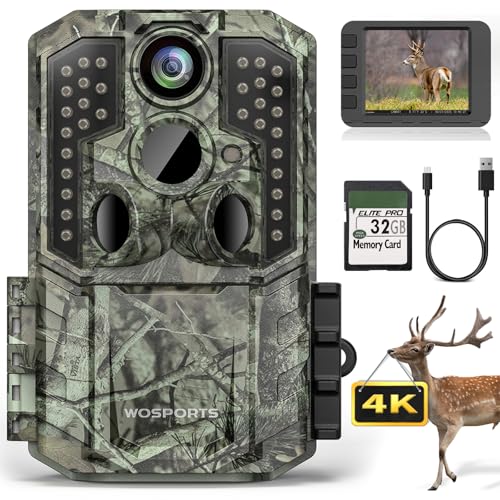
Wosports
4K 56MP
$59.99
Pros & Cons
Pros
- High 56MP stills and 4K video for around $42
- 120° wide capture and an 80 ft no-glow flash range
- 2-inch LCD makes aiming and review simple
- Cheap enough to scatter several across a property
- No subscription or app needed — straight SD-card simplicity
Cons
- 0.2s trigger is slower than the Vikeri and GardePro cams
- Budget-brand reliability varies
- Stated megapixels are interpolated, not native sensor resolution
At a Glance
Overview
The Wosports 4K 56MP is a budget trail camera built around a simple pitch: cram the biggest spec numbers possible onto the box and sell it for around forty-two dollars street. You get a 56MP stills claim, 4K video, a 120-degree wide lens, a 2-inch color setup screen, and a no-glow flash that reaches a respectable 80 feet. For the money, that's a lot of camera, and as a way to cover an extra spot cheaply it does the job. The catch — and there's always a catch at this price — is what those megapixel and resolution numbers actually mean, and how the camera holds up over time.
Let me be direct about the headline first. That 56MP figure is interpolated, not the true output of the sensor inside. The actual sensor is small, in the ballpark of 5MP native, and the camera's software stretches that data up to a 56MP file. You get a bigger image, not a more detailed one. This is standard practice across nearly every sub-$60 camera, so it's not a Wosports-specific dishonesty, but you should walk in knowing the 56 on the box is a number, not a promise of sharpness.
Where the Wosports earns its place is as a scatter-it-everywhere value camera. At this price you can buy two or three, blanket a property, and not lose sleep over any single one. The 80-foot no-glow flash range actually beats some pricier budget cams, the wide lens covers a generous scene, and the SD-card-only design means there's nothing to subscribe to and nothing to fail on a network.
The honest weak spots are the 0.2-second trigger — slower than the freakishly fast Vikeri and GardePro cams — and the typical off-brand reliability variance. If you want one dependable camera that lasts years, this isn't it. If you want cheap, wide, covert coverage to fill in gaps, the Wosports is a reasonable buy. This review walks through exactly where it shines and where it doesn't.
Wosports 56MP 4K Trail Camera (120° Wide, No-Glow)
Prices may change · Free shipping with Prime
Design, Build & Theft Resistance
The Wosports follows the standard budget box-camera template: a camo plastic housing about the size of a small paperback, a hinged front cover protecting the lens and sensor array, and a 2-inch color screen inside for aiming and reviewing captures in the field. That screen matters more than it sounds at this price — it turns a setup that would otherwise be guesswork into a quick point-and-confirm, which is exactly what a first-time buyer needs.
The build is honest budget-grade. The shell is thinner than a Browning or Reconyx, the battery door and clasp feel light in the hand, and while the IP66 rating means it shrugs off rain and snow in normal use, the sealing won't inspire the same confidence as a premium housing over multiple hard seasons. Quality varies unit to unit, which is the reality of off-brand cameras assembled to a price — most run fine, some arrive with a finicky card slot or a weak latch.
For theft resistance, expect essentially none built in. There's a strap channel and a tripod thread, but no integrated lock and no model-specific security box ecosystem. If it's going anywhere the public can reach, run a generic cable lock through the strap loop. The upside of the low price is the same as with any budget cam: a stolen Wosports is a small loss, which makes it a sensible pick for marginal public-land spots where you'd never risk a cellular camera. Genuine theft protection on valuable cameras is a home and property security topic of its own.
Detection & Trigger Speed in the Field
The Wosports triggers in about 0.2 seconds. That's perfectly serviceable and will catch most deer and wildlife moving at a normal pace, but it's meaningfully slower than the 0.05-second Vikeri or the 0.1-second GardePro cameras. On a fast-walking buck crossing a wide trail, that extra fraction of a second is the difference between a centered animal and a hindquarter at the frame edge. For feeders, pinch points, and any spot where animals slow down or mill around, the 0.2-second speed is a non-issue; for fast crossings, aim it tighter to compensate.
Now the resolution reality. The 56MP stills figure is interpolated — the camera upscales a small native sensor (roughly 5MP) into a much larger file. The image is bigger on disk, not sharper in detail. Daytime stills are genuinely usable for identifying animals and scouting movement, but cropping deep into a 56MP file won't reveal detail the little sensor never resolved. The 4K video carries the same caveat: it's a real 4K container wrapped around budget-sensor data. It's worth remembering that the $450 Reconyx in this lineup advertises just 3MP true resolution and still produces better usable images, because sensor quality and processing — not the number on the box — drive real image quality.
Detection range lands around 80 feet, which is mid-pack for a budget cam and shorter than the 100-foot triple-PIR GardePro models. Combined with the 120-degree wide lens, that range is best exploited on close-to-medium scenes: a 40-to-60-foot trail crossing, a bait site, or a field edge where you want broad coverage rather than long reach.
Night Flash: No-Glow vs Low-Glow
The Wosports uses a no-glow infrared flash built from 32 LEDs in the 940nm band. No-glow (940nm) is the covert choice: when the flash fires at night it emits virtually no visible light, so deer, trespassers, and curious neighbors see nothing. The alternative, low-glow, runs around 850nm and throws a faint red glow when it triggers — it reaches a little farther but is visible up close. That trade is the core of the no-glow vs low-glow decision, and Wosports went covert.
The good news here is range. The Wosports' no-glow flash reaches roughly 80 feet, which is notably better than the 65-foot reach of the similarly priced Vikeri and respectable for a budget no-glow camera. Budget no-glow cams typically trade flash distance for covertness, so getting a usable 80-foot cone out of an invisible flash is a genuine point in this camera's favor. Subjects out to about 60 to 70 feet at night come through usable; beyond that, the small sensor's night noise starts to dominate.
The practical setup advice: this is a covert camera that can stretch a bit farther at night than most of its budget peers. Set it on a 50-to-70-foot night crossing or a bait site and the no-glow flash does its job invisibly. If you specifically want full-color night images to identify a particular animal or a face, you need a white-flash camera instead — no-glow infrared is monochrome by nature, and that's the right tradeoff for covert hunting and discreet wildlife work.
WiFi/SD Workflow & No Monthly Fee
The Wosports is a straight SD-card camera with no WiFi, no cellular, no app, and no subscription. You drop in a microSD card (it supports up to 256GB), the camera records to it, and you walk up, pull the card, and review your photos and clips on a phone or computer. There is nothing to pay monthly, ever, and that is the entire economic argument for a camera like this.
The contrast with cellular cameras is stark on cost. A cell cam beams images to your phone from anywhere, but it carries a recurring data plan that typically runs $60 to $200 per year depending on brand and tier. Across a few seasons, one cellular subscription can cost more than a fistful of Wosports cameras. If the camera lives somewhere you pass regularly — a backyard, a property you live on, a stand you check every few days — you're getting the same core result for zero recurring spend. That no monthly fee advantage is exactly why budget SD cams stay relevant for anyone who doesn't truly need photos sent remotely.
The price of SD-only is patience and a lack of backup. You won't see what the camera captured until you physically visit it, and if the card corrupts or the camera is stolen, the images are gone with no cloud copy. Mitigate that by buying a reputable card rather than relying on a bundled throwaway, formatting it in the camera before deployment, and pulling it on a regular schedule. A 128GB card gives ample room for a season of stills plus the occasional space-hungry 4K clip.
Power, Batteries & Cold Weather
The Wosports runs on 8 AA batteries, with no rechargeable pack or factory solar option in the box. Eight cells is a standard budget appetite, and your real-world runtime hinges mostly on how much night video the camera shoots — IR flash plus 4K recording are by far the most power-hungry operations.
Battery chemistry is the lever that matters most, especially when it's cold. Alkaline AAs sag in voltage as the temperature falls, and a hard freeze can trigger false low-battery shutoffs or kill the camera outright during the exact cold mornings when deer move most. Lithium AAs hold steady voltage from far below freezing up through summer heat, deliver two to three times the life, and weigh less to pack in. For any Wosports you can't check frequently, switching to lithium is the highest-return upgrade available — it directly fixes the two biggest budget-cam gripes, cold-weather death and constant battery swaps.
With no integrated solar designed for this model, your runtime is simply whatever the 8 AAs provide. On lithium cells in a moderate-traffic setup, expect a comfortable few months; on a busy trail shooting heavy night 4K, plan to swap sooner. If genuine season-long, no-maintenance power is your priority, a camera with built-in solar is a cleaner architecture than trying to rig an external panel to this one.
Who Should Buy (And Who Shouldn't)
Buy the Wosports 4K 56MP if you want cheap, wide, covert coverage and you value an 80-foot no-glow night range over the absolute fastest trigger. It's a solid second or third camera for blanketing a property, a low-risk choice for a marginal public-land spot, and a friendly no-fee entry point for a beginner who wants a setup screen and nothing to subscribe to. For backyard wildlife and casual scouting where animals aren't sprinting through, the 0.2-second trigger is plenty and the wide lens earns its keep.
Don't buy it as your single, must-not-fail camera if a QC dud would wreck a season — off-brand variance is real, and a more dependable camera belongs on your highest-value setup. Don't buy it expecting truly sharp 56MP detail or magazine-grade 4K; those numbers are spec-sheet wrappers around a small sensor. And if you want photos sent to your phone from afar, that's a cellular camera's job, not this one's.
The right way to think about the Wosports is volume coverage on a budget. Two of these cover far more ground than one mid-priced camera for similar money, and the slightly longer night flash makes each one a touch more useful after dark than the cheapest alternatives.
Alternatives Worth Considering
If you want the same budget-and-4K formula but the fastest possible trigger, the Vikeri 4K 48MP is the direct sibling. It trades the Wosports' 80-foot flash for a shorter 65-foot night reach, but its 0.05-second trigger is the quickest in the lineup and its 130-degree lens is even wider. Pick the Wosports for night range, the Vikeri for shutter speed — they're two flavors of the same scatter-it-cheap idea.
If real image quality matters more than spec-sheet megapixels, step up to the GardePro A3S at around $60. Its genuine Sony Starvis sensor produces night images that embarrass cameras costing far more, it reaches a true 100-foot day-and-night detection range, triggers in the 0.1-second class, and stays covert with a 940nm no-glow flash — all with no monthly fee. For most buyers it's the smarter long-term value, trading a few dollars for meaningfully better real-world results.
If you want to spend the absolute least and don't need 4K, the GardePro A3 delivers dependable GardePro low-light performance and a 0.1-second trigger at the lowest price here. The consistent lesson across these options: a small step up in budget usually buys better build and better true image quality rather than just larger numbers on the box.
Our Verdict
A fine value second or third camera for covering extra spots cheaply. The high MP and 4K read well on the box; just don't expect flagship trigger speed or longevity.
Wosports 56MP 4K Trail Camera (120° Wide, No-Glow)
$59.99
Prices may change · Free shipping with Prime
| Full Specifications | |
|---|---|
| Connectivity | sd |
| Monthly fee | None |
| Night flash | no-glow |
| Photo resolution | 56MP |
| Trigger speed | 0.2s |
| Detection range | 80ft |
| Flash range | 80ft |
| Power | 8x AA |
| Weather rating | IP66 |
| Storage | microSD up to 256GB |
| Video | 4K |
Frequently Asked Questions
Is the 56MP resolution real?
How fast is the trigger?
Does it need a monthly subscription?
How far does the night flash reach?
What memory card does it use?
Is it covert for hunting?
What batteries are best for it?
Is one Wosports enough or should I buy several?
Compare With Similar Trail Cameras
Head-to-Head Comparisons
Wosports 56MP 4K Trail Camera (120° Wide, No-Glow)
$59.99
Prices may change · Free shipping with Prime