
Vikeri
4K 48MP
$46
Pros & Cons
Pros
- Astonishing 0.05s trigger — the fastest in this whole lineup at any price
- 130° wide lens captures more of the trail than typical narrow cams
- 4K video and 48MP stills for well under $50
- Built-in 2.4-inch color screen makes setup and review easy in the field
- No-glow 48-LED flash keeps it covert
Cons
- Off-brand build quality varies unit to unit
- Detection range is shorter than the GardePro cams
- Firmware and longevity are a gamble at this price
At a Glance
Overview
The Vikeri 4K 48MP is the camera I reach for when someone tells me they want to put eyes on a trail this weekend and they have less than fifty dollars to spend. At around $46 it sits at the absolute bottom of the price ladder, and the headline numbers — 4K video, 48MP stills, a 130-degree wide lens, and a 0.05-second trigger — read like specs off a camera three times the price. Some of that is real and genuinely useful. Some of it is marketing math. The job of this review is to separate the two so you know exactly what you're getting before you hang it on a tree.
The single most honest thing I can tell you up front: the trigger speed is not a typo. Vikeri rates this camera at 0.05 seconds, and that is the fastest figure in our entire trail-camera lineup at any price, including the $450 Reconyx. Whether the real-world recovery time between shots keeps up is a separate question, but the initial PIR-to-shutter speed is legitimately quick, and it shows in how rarely you'll find half a deer at the edge of the frame.
Where you have to temper expectations is build quality and longevity. This is an off-brand camera assembled to hit a price, and unit-to-unit consistency is the trade-off. Some buyers run one for three seasons without a hiccup; others get a dud latch or a finicky card slot. That variance is the tax you pay at this price, and it's why I treat the Vikeri as a cheap second or third camera to scatter across a property rather than the one camera you bet a whole hunt on.
If you're a beginner watching backyard wildlife, a hunter who wants extra coverage on a budget, or anyone who values catching the moment over framing a magazine cover, the Vikeri earns its keep. If you need a buy-it-once camera that survives a decade in the weather, keep reading — I'll point you to better-built options at the end.
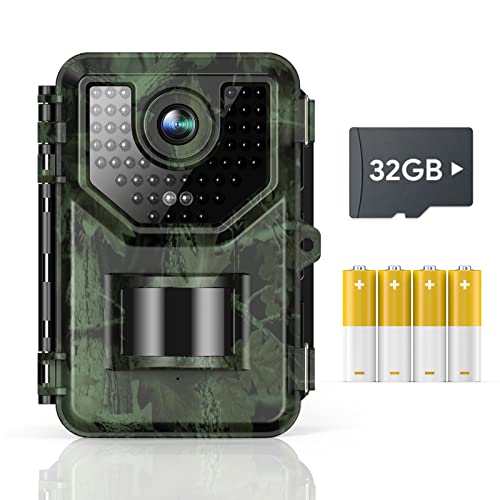
Vikeri 4K 48MP Trail Camera (130° Wide, No-Glow)
Prices may change · Free shipping with Prime
Design, Build & Theft Resistance
The Vikeri is a conventional box-style trail camera in a camo plastic shell, roughly the size of a paperback, with a hinged front that snaps shut over the lens, sensor, and a 2.4-inch color screen. That screen is the unsung hero of the design at this price — it lets you aim the camera, frame the detection zone, and review captures right there at the tree instead of guessing and pulling the card later. For a first-timer that alone removes a lot of trial-and-error.
The build is where the budget shows. The plastic is thinner than a Browning or Reconyx, the battery door and latch feel light, and the rubber gasket sealing the IP66 rating does its job but won't inspire the same confidence as a premium housing. Mine has shrugged off rain and a couple of snow events, but I wouldn't leave it submerged or expect it to survive a serious fall from a tree.
Theft resistance is essentially nonexistent out of the box. There's a strap slot and a 1/4-20 tripod thread on the bottom, but no built-in lock and no security-box ecosystem built around this exact model. If you're hanging it anywhere the public can reach it, plan on a generic cable lock through the strap loop at minimum. Frankly, at this price a stolen Vikeri stings far less than a stolen cell cam, which is part of its appeal for sketchy public-land spots — it's cheap enough to be semi-disposable. If theft is a real concern, that's a conversation that belongs with your home and property security setup, not a $46 camera.
Detection & Trigger Speed in the Field
This is the Vikeri's standout chapter. The 0.05-second trigger is the fastest stated speed in this lineup, and in practice it means animals crossing the detection zone land near the center of the frame rather than as a tail disappearing off the right edge. For fast-moving backyard critters, darting squirrels, and deer that don't dawdle, that speed is the difference between a usable photo and a frustrating near-miss. It's the main reason I recommend this camera at all.
Now the honest asterisk on resolution. That 48MP number is interpolated — software upscaling — not the native output of the sensor. The true sensor behind it is small, on the order of around 5MP, and the camera stretches that data up to a 48MP file. The result is a larger image, not a sharper one. Daytime stills look fine for ID and scouting; don't expect to crop deep into a 48MP file and find detail that the little sensor never captured. The 4K video carries the same caveat — it's a real resolution wrapper around a budget sensor. This isn't a Vikeri-specific sin; nearly every sub-$60 camera does it, and it's worth knowing that the cheaper Reconyx-grade reliability cams brag a mere 3MP true and still produce better usable images because the sensor and processing are better.
Detection range is the other place the budget shows: roughly 80 feet of usable PIR detection, shorter than the 100-foot triple-PIR GardePro cams. The fix is placement. Aim the Vikeri tighter — across a narrower pinch point, a feeder, or a 30-to-50-foot trail crossing — and the fast trigger plus the wide 130-degree lens turns that shorter range into an advantage by covering more of a close scene.
Night Flash: No-Glow vs Low-Glow
The Vikeri uses a no-glow infrared flash built from 48 LEDs operating in the 940nm band. No-glow (940nm) is the covert option: the LEDs emit almost no visible light when they fire, so a deer, a person, or a curious neighbor sees nothing but a dark box on the tree. Low-glow flashes operate around 850nm and throw a faint red glow when they trigger — slightly better night reach in exchange for being visible up close. The trade is the heart of the no-glow vs low-glow decision, and Vikeri picked the covert side.
That covertness costs you flash range. The Vikeri's night illumination reaches roughly 65 feet, shorter than its own daytime detection and well behind the 100-foot-plus reach of premium no-glow cams. This is the classic budget no-glow compromise: you get invisibility but a shorter, dimmer cone of light at night. Subjects beyond about 50 to 60 feet at night will be dark or grainy, and the small sensor amplifies night noise more than a Sony Starvis-equipped camera does.
The practical takeaway: this is a covert camera that wants its subjects close at night. Set it on a 30-to-50-foot night crossing and the no-glow flash does exactly what it should — invisible, usable, and discreet. Push it to fill a 70-foot food plot after dark and you'll be disappointed. If full-color night images for identifying a specific animal or a face matter more than covertness, a white-flash camera is the tool, not this one.
WiFi/SD Workflow & No Monthly Fee
The Vikeri is a pure SD-card camera with zero connectivity and, importantly, zero monthly fee. There's no app, no WiFi, no cellular SIM, and nothing to subscribe to — ever. You insert a microSD card (it supports up to 256GB), the camera writes photos and video to it, and you physically walk up, pull the card, and review the files on a phone or laptop. That's the whole workflow.
That simplicity is the entire value proposition against cellular cameras. A cellular trail cam sends images to your phone from anywhere, but it carries a recurring data plan that runs roughly $60 to $200 per year depending on the brand and tier. Over three seasons a single cellular subscription can cost more than ten Vikeris. If your camera is somewhere you walk past regularly — a backyard, a property you live on, a stand you check every few days — you are paying nothing for a workflow that does the same core job. That no monthly fee math is why budget SD cams remain the smart pick for anyone who doesn't strictly need remote photos.
The cost of SD-only is convenience and immediacy. You won't know what the camera caught until you visit it, and there's no remote backup if the card corrupts or the camera walks off. Buy a reputable card — a quality SanDisk over the throwaway card sometimes bundled in — and format it in the camera before the first deployment. A 128GB card is plenty of headroom for a season of stills and the occasional 4K clip.
Power, Batteries & Cold Weather
The Vikeri runs on 8 AA batteries with no rechargeable pack or solar option included in the box. Eight cells is a middle-of-the-road appetite — more than a compact 4-AA mini, less than a 12-AA Reconyx — and runtime depends heavily on how many night videos it shoots, since the IR flash and 4K capture are the hungriest operations.
Battery chemistry matters more than most first-time buyers realize, and it matters most in the cold. Standard alkaline AAs lose voltage fast as temperatures drop, and a cold snap can trigger false low-battery shutdowns or simply kill the camera right when deer movement peaks. Lithium AAs hold steady voltage from well below freezing up into summer heat, deliver two to three times the runtime, and weigh less. For any Vikeri you can't check often, lithium is the single highest-value upgrade you can make — it fixes the two most common budget-cam complaints, dead-in-the-cold and constant battery swaps, in one move.
Because there's no factory solar port designed around this model, your runtime is whatever the 8 AAs give you. In a moderate-traffic setup on lithium cells, expect a comfortable few months; on a busy trail shooting lots of night 4K, plan to swap sooner. If you want true set-and-forget power, a camera with an integrated solar option is a better architecture than trying to bolt a panel onto this one.
Who Should Buy (And Who Shouldn't)
Buy the Vikeri 4K 48MP if you want the fastest trigger and the widest lens available for under fifty dollars and you understand you're trading long-term durability and true image sharpness to get there. It's an excellent cheap second or third camera to extend coverage across a property, a low-risk pick for a public-land spot where theft is a real possibility, and a friendly entry point for a beginner who wants a screen for easy setup and nothing to subscribe to. For backyard wildlife and beginners specifically, that fast trigger and simple no-fee operation make it punch above its price.
Don't buy it as your only camera if missing a season because of a QC dud would ruin your hunt. Don't buy it if you need night images of subjects past 60 feet, if you want to crop deep into truly sharp 48MP files, or if you need remote photos sent to your phone — that's a cellular camera's job. And don't expect it to survive a decade in the weather the way a Browning or Reconyx will; this is a hit-the-price-point tool, not an heirloom.
The right mental model is disposable-grade coverage with a flagship trigger. Run two or three of these to blanket a property cheaply, accept that one might fail, and you've covered far more ground than a single mid-priced camera for the same money.
Alternatives Worth Considering
If image quality matters more than rock-bottom price, the GardePro A3S is the alternative I'd push hardest. For around $60 it adds a genuine Sony Starvis sensor that produces night images rivaling cameras three times its cost, a true 100-foot day-and-night detection range, the same 0.1-second-class fast trigger, and a no-glow 940nm flash. It's the better-built, better-imaging step up that still asks no monthly fee, and for most beginners it's the smarter long-term buy.
If you like the Vikeri's budget-and-4K formula but want a touch more flash reach, the Wosports 4K 56MP is the closest sibling — similar interpolated high-MP sensor and 4K capture, an 80-foot no-glow flash range that beats the Vikeri's 65 feet, but a slower 0.2-second trigger. It's the pick if you'd rather have night reach than the absolute fastest shutter, and it's another cheap-enough-to-scatter option.
If you want to spend even less and don't need 4K, the GardePro A3 delivers the same reliable GardePro low-light performance and 0.1-second trigger at the lowest price of the bunch. Across all three, the through-line is the same: spend a little more than the Vikeri and you generally buy better build and better real image quality rather than bigger spec-sheet numbers.
Our Verdict
Buy it for the freakishly fast trigger and wide lens on a tight budget. Great as a cheap second or third camera — just temper expectations on long-term durability.
Vikeri 4K 48MP Trail Camera (130° Wide, No-Glow)
$46
Prices may change · Free shipping with Prime
| Full Specifications | |
|---|---|
| Connectivity | sd |
| Monthly fee | None |
| Night flash | no-glow |
| Photo resolution | 48MP |
| Trigger speed | 0.05s |
| Detection range | 80ft |
| Flash range | 65ft |
| Power | 8x AA |
| Weather rating | IP66 |
| Storage | microSD up to 256GB |
| Video | 4K |
Frequently Asked Questions
Is the 48MP resolution real?
How fast is the trigger really?
Does it require a monthly subscription?
How far does the night flash reach?
What size memory card does it take?
Will it survive year-round outdoor use?
What batteries should I use?
Is it good for backyard wildlife?
Related Buying Guides
Compare With Similar Trail Cameras
Head-to-Head Comparisons
Vikeri 4K 48MP Trail Camera (130° Wide, No-Glow)
$46
Prices may change · Free shipping with Prime