
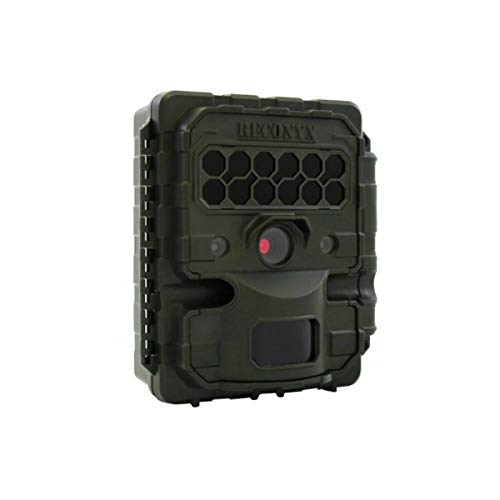
Reconyx
HyperFire 2 HP2X
$450
Pros & Cons
Pros
- Bulletproof reliability with a 0.2s trigger — it captures what cheaper cams miss
- 1-year-plus battery life on 12 AAs for true long-haul deployments
- True no-glow covert IR for sensitive security and trophy-property scouting
- Made in the USA with near-lifetime durability
- No subscription and SD support to 512GB — a buy-it-once tool
Cons
- Very expensive for an SD camera
- Only 3MP true resolution — reliability over megapixels
- No video; this is a stills-focused security and research cam
At a Glance
Overview
The Reconyx HyperFire 2 HP2X is the camera that ruins you for everything cheaper. At around $450 for a non-cellular, 3-megapixel, video-less SD camera, the spec sheet looks indefensible next to a $46 Vikeri boasting 4K and 48 interpolated megapixels. And yet the people who run Reconyx — researchers, security pros, trophy-property managers, and serious hunters — buy them on purpose, often by the dozen, and almost never go back. Understanding why is the whole point of this review, because nearly everything that matters about the HP2X lives in the spaces the spec sheet doesn't measure.
Start with what the numbers do say. The HP2X triggers in about 0.2 seconds, runs over a year on 12 AA batteries, uses a true no-glow covert infrared flash, detects out to roughly 100 feet, and supports SD cards up to 512GB. It's made in the USA, wrapped in an OD-green housing built to a near-lifetime durability standard, and it asks for no subscription of any kind. Those are the bones of a buy-it-once tool.
Now the part the spec sheet hides: reliability. A Reconyx does what it says it will do, every single time, for a year, in heat and cold and rain, without a missed trigger, a corrupted card, a firmware lockup, or a mysteriously dead battery. The 3MP sensor is small on paper but produces clean, properly exposed, genuinely usable images because the optics, exposure logic, and processing are excellent — which is why a 3MP Reconyx routinely beats a 48MP budget cam's actual photos. Megapixels were never the point.
This review is honest about who should and shouldn't spend Reconyx money. If a missed frame or a dead camera is merely annoying, you don't need one and shouldn't pay for one. If a missed frame or a dead camera is unacceptable — a security incident you failed to capture, a research dataset with a gap, a once-a-year trophy you'll never see again — the Reconyx tax is cheap. Here's how to tell which camp you're in.
Reconyx HyperFire 2 Professional Covert IR Trail Camera (OD Green)
Prices may change · Free shipping with Prime
Design, Build & Theft Resistance
The HP2X comes in a compact OD-green housing that is unmistakably built to a different standard than the consumer cameras in this lineup. Where budget cams use thin camo plastic and light latches, the Reconyx feels dense and deliberate — tight seams, a solid door, and a sealing system designed to keep moisture out across years of deployment rather than a season or two. This is a made-in-the-USA tool engineered for professionals who hang a camera and trust it to still be working a year later, and the build communicates that the moment you pick it up.
The form factor is intentionally understated. The OD-green color and small profile help it disappear against bark, which matters for both wary game and security applications where you don't want the camera spotted. There's no flashy setup screen — Reconyx keeps the interface minimal and bulletproof rather than feature-laden — and the menu, while spartan, is the kind that simply never locks up or misbehaves in the field.
Theft and tamper resistance is where the Reconyx ecosystem earns its keep. Reconyx designs and sells security enclosures and lock options specifically for its cameras, and the housing accommodates cable locks and steel boxes cleanly. Given that these cameras are frequently deployed on public land, research sites, and remote property — exactly where theft and bears are real risks — a model-specific steel security box plus a cable lock is standard practice, and a worthwhile investment to protect a $450 camera. For serious property security setups this is the camera you actually want locked down, not a disposable budget cam.
Detection & Trigger Speed in the Field
The HP2X's 0.2-second trigger is the headline that actually matters, and it's the reason Reconyx has a near-mythic reputation. It isn't the fastest stated number in this lineup — a budget Vikeri claims 0.05 seconds on paper — but stated trigger speed and real-world capture reliability are very different things. What separates the Reconyx is that it hits its 0.2 seconds consistently, every trigger, with a fast recovery between frames, so it captures sequences that cheaper cameras start and then drop. It catches what other cameras miss not because the single number is lowest, but because it never has an off day.
Then there's the resolution conversation, which is the most important thing to understand about this camera. The HP2X is a true 3-megapixel camera. There is no interpolation, no upscaling, no 48MP marketing number stretched out of a tiny sensor. That 3MP is the honest, native output — and it produces images that are clean, correctly exposed, sharp where it counts, and free of the noise and mush that plague budget sensors. A budget camera advertising 48MP or 56MP is interpolating a roughly 5MP sensor up to a bigger file that isn't actually more detailed; the Reconyx's smaller true sensor, paired with far better optics and image processing, delivers better real-world photos than those inflated numbers. If you only learn one thing from this lineup, let it be that real image quality comes from sensor quality and processing, not the megapixel count on the box.
Detection reaches a genuine 100 feet, on par with the best in the category, and it's a reliable 100 feet rather than an optimistic one. Combined with the consistent trigger, that means the HP2X actually fills its detection zone with captures instead of missing the fast or distant ones. For research counts, security perimeters, and patterning a specific animal, that consistency is the entire value.
Night Flash: No-Glow vs Low-Glow
The HP2X uses a true no-glow covert infrared flash operating in the 940nm band. No-glow (940nm) means the flash emits essentially no visible light when it fires at night — the camera stays completely dark and invisible to deer, people, and anything else looking back at it. The alternative, low-glow, runs around 850nm and produces a faint red glow when triggered; it reaches a bit farther but gives the camera's position away. For the security, research, and pressured-game work the Reconyx is built for, true covertness isn't a nice-to-have, it's the requirement, and 940nm no-glow is the right and deliberate choice.
Reconyx's no-glow flash is rated to roughly 50 feet, which is shorter than the 100-foot-plus reach some low-glow and white-flash cameras advertise. That's the fundamental no-glow tradeoff: invisibility costs you raw flash distance, because 940nm light is harder for the sensor to see than 850nm. Reconyx accepts that trade in exchange for being undetectable, and then makes the most of the 50 feet it has with excellent exposure control — night images inside that range are clean and properly lit rather than blown-out or murky.
The practical guidance is to set the HP2X up to put its night subjects inside that 50-foot covert flash zone — a trail crossing, a scrape, a gate, a perimeter point. Within that range it delivers exactly what professionals need: invisible, reliable, properly exposed night captures, frame after frame. If your priority were instead long-range night reach or full-color night identification, a low-glow or white-flash camera would serve better — but those cameras announce themselves, which defeats the purpose of running a Reconyx in the first place. The no-glow vs low-glow decision, for this camera's users, isn't close.
WiFi/SD Workflow & No Monthly Fee
The HP2X is a pure SD-card camera with no WiFi, no cellular, and no subscription — and it supports cards up to a generous 512GB. You insert a card, the camera records to it for as long as a year on a set of batteries, and you pull the card to review captures. Reconyx also makes a cellular sibling (the HS2XC) for users who need images sent remotely, but the HP2X is deliberately the no-network, no-fee version for people who value reliability and a local backup over remote convenience.
That no monthly fee design is a real economic argument even at this price. A cellular camera carries a recurring data plan of roughly $60 to $200 per year, every year, for as long as you run it. The HP2X costs nothing after purchase, and over the many years a Reconyx typically lasts, avoiding a decade of subscription fees offsets a meaningful chunk of that premium price. For a security or research deployment that runs continuously, the absence of any recurring cost — and the absence of any cloud dependency that could fail — is part of the professional appeal, not a compromise.
The other advantage of SD-with-huge-capacity is that the card itself is a physical, local backup. There's no cloud-only single point of failure; the images live on the card in your hand. The 512GB ceiling means even a year-long deployment shooting thousands of stills won't run out of room. Pair it with a high-quality, high-capacity card, format it in the camera, and the HP2X becomes a true set-it-and-forget-it instrument — hang it, walk away, and collect a full year of reliable captures.
Power, Batteries & Cold Weather
Battery life is one of the HP2X's signature strengths: it runs over a year on 12 AA batteries. That 12-cell bank is larger than the 8-AA budget cameras and the 6-AA Brownings, and combined with Reconyx's famously efficient electronics it delivers runtime that genuinely measures in seasons, not weeks. For a camera meant to be hung in a remote spot and left alone, that year-plus endurance is the entire deployment model — you're not making battery trips to a research site or a far gate every month.
Chemistry still matters, and Reconyx is explicit that lithium AAs are the way to realize that full year of life. Lithium cells hold steady voltage across extreme temperatures — they don't sag and die in the cold the way alkalines do — and a Reconyx is precisely the kind of camera that sits out through deep winter where that matters most. Running quality lithium AAs isn't optional if you want the headline runtime and reliable cold-weather operation; it's the assumed configuration. The good news is that with a year between swaps, the cost-per-month of even premium lithium cells is trivial.
There's no integrated solar on the HP2X, but with year-plus battery life it scarcely needs one — the whole point is that you set it and don't return for a long time. Some users on continuous-duty security deployments do add an external power solution, but for the vast majority of buyers, a fresh set of 12 lithium AAs once a year is the simplest, most reliable power plan there is. This is the camera that solves the dead-in-the-cold and constant-swap complaints not with gadgetry but with sheer efficiency and a big, lithium-friendly battery bank.
Who Should Buy (And Who Shouldn't)
Buy the Reconyx HyperFire 2 HP2X if a missed frame or a dead camera is genuinely unacceptable. That describes property and security professionals documenting a perimeter, wildlife researchers who can't have gaps in a dataset, land managers and trophy-property owners who get one chance at a specific animal, and serious hunters who would rather own one camera that never fails than three that sometimes do. For these users the high price buys the one thing budget cameras can't: certainty. Across years of service, the no-subscription design also means the upfront cost is much of the total cost.
Don't buy it if you're a casual user, a backyard wildlife watcher, or a budget-conscious hunter for whom an occasional missed photo or a once-a-season battery hassle is merely annoying rather than costly. You will not get $450 of value out of a 3MP no-video camera if your needs are casual — you'll get better-feeling specs and more fun for far less money from a GardePro A3S or a Browning. And if you specifically want video, 4K, or full-color night images, the HP2X simply doesn't do those things; it's a stills-focused reliability instrument by design.
The honest framing is this: the Reconyx is insurance, and insurance only makes sense when the thing it protects against is expensive. If the cost of a miss is high, the HP2X is the cheapest way to never miss. If the cost of a miss is low, almost anything else in this lineup is the smarter buy.
Alternatives Worth Considering
If you want Reconyx-grade reliability with remote photo delivery, the Reconyx HyperFire 2 HS2XC is the cellular sibling — the same legendary trigger, build, and covert no-glow flash, plus IntelliTag AI and 4G LTE so images come to your phone. It trades the HP2X's no-fee simplicity for a carrier data plan, and it's the pick when a security or scouting site is too remote to visit but you still demand Reconyx dependability.
If the Reconyx price is more than your needs justify but you still want a premium, no-subscription SD camera, the Browning Strike Force Pro X 1080 is the value benchmark. At roughly $140 it offers excellent day and night image quality, a 0.22-second trigger, a 120-foot no-glow flash reach, and Browning's famous battery life on just 6 AAs — covertness and quality at a third of the cost, accepting that it won't match Reconyx's bulletproof, year-after-year consistency.
If video matters and you can live with a faint night glow, the Browning Recon Force Elite HP5 delivers the best 1080p/60 video with sound in this lineup and a 130-foot flash, though its low-glow flash isn't fully covert. The common thread: the Reconyx wins on pure reliability and covertness; the Brownings win on image features and value. Pick the Reconyx when uptime is non-negotiable, and a Browning when you want premium results without the buy-it-once price.
Our Verdict
The no-subscription counterpart to the cellular Reconyx: the SD cam to buy when uptime and reliability are everything and you'll never touch it for a year. Overkill for casual users, perfect for security and research.
Reconyx HyperFire 2 Professional Covert IR Trail Camera (OD Green)
$450
Prices may change · Free shipping with Prime
| Full Specifications | |
|---|---|
| Connectivity | sd |
| Monthly fee | None |
| Night flash | no-glow |
| Photo resolution | 3MP |
| Trigger speed | 0.2s |
| Detection range | 100ft |
| Flash range | 50ft |
| Power | 12x AA |
| Weather rating | Weatherproof |
| Storage | SD up to 512GB |
| Video | None |
Frequently Asked Questions
Why does a 3MP camera cost $450 when budget cams claim 48MP?
Is the trigger really faster than a 0.05-second budget camera?
Does it shoot video?
Is the flash covert?
Does it need a subscription?
How long do the batteries last?
Who is this camera actually for?
Should I lock it up?
Related Buying Guides
Compare With Similar Trail Cameras
Reconyx
HyperFire 2 HS2XC
cellular · Carrier plan required · no-glow
$659.99
Spypoint
Flex-S
cellular · Free tier (100 photos); from $10/mo · low-glow
$168.08
Head-to-Head Comparisons
Reconyx HyperFire 2 Professional Covert IR Trail Camera (OD Green)
$450
Prices may change · Free shipping with Prime